
No products in the cart.
LLM Servers · Inference · Fine-Tuning · Built in LA
Production LLM servers, tuned to ship tokens.
Custom rackmount servers for large language model inference, fine-tuning, and on-premise deployment. Dual AMD EPYC, multi-GPU NVIDIA RTX PRO Blackwell with NVLink, ECC DDR5, and PCIe Gen5 NVMe storage. Pre-configured with vLLM, TensorRT-LLM, and the full Hugging Face stack. Hand-assembled in Los Angeles.
Trusted by AI Engineering Teams, Research Labs, Government Agencies, Enterprise AI


Real AI & LLM Deployments
Real systems. Real customer deployments.
See how VRLA Tech configures Blackwell workstations and GPU servers around local AI, inference, software development, and production deployment requirements.
8-GPU · Production AI Server
Goodwill NCW · 8× RTX PRO 6000 Blackwell
A production rackmount AI server with eight RTX PRO 6000 Blackwell Server Edition GPUs and 768GB of aggregate GPU memory for concurrent AI workloads.
View Case Study → 3-GPU · Local LLM DevelopmentReapt · 3× RTX PRO 6000 Blackwell
A 288GB-GPU-memory workstation built for concurrent local LLM inference pipelines and AI-native software development.
View Case Study → 96GB VRAM · Local AIColorado AI · RTX PRO 6000 Blackwell
A high-VRAM professional workstation configured for local AI development and demanding compute workflows without relying entirely on cloud infrastructure.
View Case Study →
Large Language Model Use Cases
Built around your model, users, and deployment.
VRLA Tech sizes LLM infrastructure around model precision, context length, concurrency, privacy requirements, fine-tuning method, and software stack—not just GPU count.
Private On-Prem LLMs
Run open-weight or internally fine-tuned models on infrastructure you control for sensitive data, proprietary IP, regulated environments, and workloads that should not depend on external APIs.
Production Inference & API Serving
Multi-GPU systems for vLLM, TensorRT-LLM, TGI, and OpenAI-compatible endpoints, sized around target latency, token throughput, request concurrency, and context length.
RAG & Document Intelligence
Infrastructure for retrieval-augmented generation, embedding models, rerankers, vector databases, document processing, and private knowledge assistants.
LoRA & QLoRA Fine-Tuning
High-VRAM GPU configurations for parameter-efficient fine-tuning, supervised fine-tuning, evaluation, and domain adaptation without requiring a full multi-node training cluster.
Agentic AI & Internal Copilots
Dedicated compute for tool-using agents, internal assistants, workflow automation, coding copilots, and multi-agent applications that need predictable local inference capacity.
Multi-Model Serving
Serve multiple models or model replicas on one system for routing, A/B testing, specialized agents, multilingual workloads, or teams sharing dedicated GPU infrastructure.
Domain-Specific Models
Deploy and adapt models for engineering, research, finance, legal, healthcare, scientific, and other specialized workflows while keeping model weights and data under your control.
Distributed Training & Cluster Nodes
GPU servers can be configured as standalone systems or as nodes in larger training and inference clusters with high-speed networking selected around the communication pattern.
Choose Your LLM Server
Two configurations. From dense inference to full fine-tuning.
The featured 2U and 4U platforms use dual AMD EPYC and NVIDIA RTX PRO 6000 Blackwell Server Edition GPUs. The 2U is designed for dense production inference, while the 4U provides additional GPU, storage, networking, and thermal capacity for larger serving and fine-tuning workloads. Custom rackmount designs can scale to 10 GPUs when the workload and chassis require it. Software stacks can be installed and validated to your deployment requirements.

01 · 2U LLM Server
Configure & Buy →
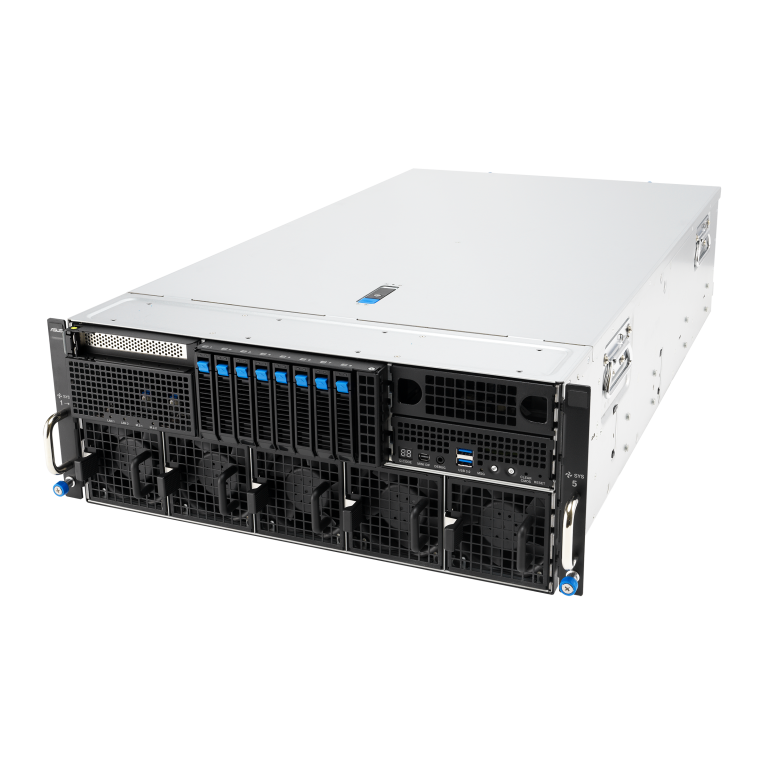
2U LLM Inference Server
Dense inference platform for local and production LLM serving. Dual EPYC with up to 4 RTX PRO 6000 Blackwell Server Edition GPUs, sized around model precision, context length, concurrency, and target token throughput.
CPUDual AMD EPYC · 64–128 cores
GPUUp to 4× RTX PRO 6000 Blackwell Server Edition · 96 GB
VRAMUp to 384 GB · aggregate GPU memory
RAMUp to 768 GB DDR5 ECC · 24-channel
Storage4 TB NVMe Gen5 + 16 TB SSD
02 · 4U LLM Server
Configure & Buy →
4U LLM Training & Serving Server
High-density platform for multi-GPU inference, parameter-efficient fine-tuning, distributed training, and high-concurrency serving. Up to 8 RTX PRO 6000 Blackwell Server Edition GPUs with topology selected for the required communication pattern and chassis.
CPUDual AMD EPYC · 96–192 cores
GPUUp to 8× RTX PRO 6000 Blackwell Server Edition · 96 GB
VRAMUp to 768 GB · aggregate GPU memory
RAMUp to 1.5 TB DDR5 ECC · 24-channel
Storage8 TB NVMe Gen5 + 32 TB SSD
Validated & Popular Frameworks
Pre-configured for the LLM stack you actually use.
When requested, VRLA Tech LLM servers can ship with the required NVIDIA drivers, CUDA toolkit, vLLM, TensorRT-LLM, Hugging Face Transformers, DeepSpeed, containers, and supporting libraries installed and validated for the customer's deployment. The exact stack is matched to the model, operating system, framework versions, and serving requirements.

vLLM
Open-source high-throughput LLM serving engine. PagedAttention delivers continuous batching with minimal memory waste — the default starting point for most production deployments.
TensorRT-LLM
NVIDIA's optimized inference stack for supported GPUs, with features including kernel fusion, quantization, and in-flight batching. Useful when deployment teams want to optimize latency and throughput on NVIDIA hardware.

OpenAI Triton
Python-based GPU kernel language for custom attention, fused operations, and quantization. Powers the inner loops of vLLM, SGLang, and most modern LLM inference engines.

Hugging Face
The model hub plus Transformers, TGI (Text Generation Inference), and Accelerate. Direct access to Llama, Mistral, Qwen, DeepSeek, and thousands of fine-tuned variants.

DeepSpeed
Microsoft's distributed training library. ZeRO sharding can distribute model states across multiple GPUs and nodes, reducing per-GPU memory pressure for large-model training and fine-tuning workflows.
NVIDIA CUDA
The backbone of NVIDIA GPU acceleration. CUDA, cuDNN, NCCL, and related libraries can be installed and version-matched to the selected inference or fine-tuning stack.
Cloud LLM API vs Self-Hosted
API token bills out of control? Run the numbers.
For sustained, predictable LLM workloads, self-hosted infrastructure can shift spending from variable API or cloud-GPU usage to owned compute. The economics depend on model size, utilization, power, staffing, API pricing, and hardware cost. Self-hosting can also provide predictable capacity and greater control over data and model deployment for sensitive or proprietary workloads.
Owned Compute
No Provider Per-Token Charge
Dedicated Capacity
Sized for Your Workload
Full Data Sovereignty
Air-Gap Capable · No Per-Token Billing
Why LLM Servers Are Different
VRAM, GPU topology, PCIe bandwidth, KV cache.
LLM serving and fine-tuning have hardware demands distinct from many general ML workloads. Model precision and GPU memory determine what can fit; GPU topology and communication bandwidth affect multi-GPU scaling; PCIe routing affects data movement; and KV cache requirements grow with context length and concurrency. The system has to be designed as a whole.
01 · AGGREGATE VRAM
Model size dictates the floor
A 70B-class model at BF16 requires roughly 140GB just for weights before KV cache and framework overhead. Quantization can reduce the footprint substantially. Multi-GPU systems increase the aggregate memory available to frameworks that explicitly shard models across GPUs; usable capacity and performance depend on the serving or training strategy.
96 GB / GPU384 GB · 2U768 GB · 4U
02 · GPU TOPOLOGY & INTERCONNECT
Communication matters
Tensor parallelism and distributed training require frequent GPU-to-GPU communication. PCIe Gen5, PCIe switches, NCCL, and—where supported by the selected GPU/chassis topology—NVLink can all affect scaling. VRLA Tech matches the interconnect design to the workload rather than assuming one topology fits every deployment.
PCIe Gen5NCCLTopology-Aware
03 · DUAL EPYC · PCIe
Lanes feed the GPUs
AMD EPYC platforms provide the high PCIe lane counts and memory bandwidth needed for dense GPU servers, but actual GPU link width and routing depend on the CPU generation, motherboard, PCIe switches, and chassis design. VRLA Tech validates the complete topology for the intended GPU count and workload.
Dual EPYCPCIe Gen5High Memory BW
04 · KV CACHE MEMORY
Concurrency lives here
Every active request consumes KV cache memory proportional to context length. Long contexts (32K-128K) and high concurrency demand massive aggregate VRAM. PagedAttention in vLLM extracts maximum tokens per GB.
vLLMPagedAttnContinuous Batch
Why VRLA Tech
Stack-tuned. CUDA-validated. LLM-supported.
Since 2016 VRLA Tech has built custom workstations and servers for demanding compute workloads. LLM systems are configured around model size, precision, context length, concurrency, fine-tuning method, storage, networking, GPU count, and software requirements rather than a fixed one-size-fits-all SKU.
Up to 10-GPU custom rackmount designs
Featured 2U and 4U platforms scale to 4 and 8 RTX PRO 6000 Blackwell Server Edition GPUs, with custom rackmount configurations available up to 10 GPUs when the chassis, power, cooling, and workload support it.
AMD EPYC server platforms
High PCIe lane counts and memory bandwidth support dense multi-GPU configurations. CPU generation, board routing, PCIe switches, DIMM population, and networking are selected around the actual server design.
LLM stack configured to order
When requested, VRLA Tech can install and validate NVIDIA drivers, CUDA, vLLM, TensorRT-LLM, Hugging Face, DeepSpeed, containers, and other required components against the customer's chosen OS and model stack.
Air-gap capable
Fully on-premise deployment for defense, healthcare, finance, and proprietary research — no cloud dependencies for inference or fine-tuning. Open-weight Llama, Mistral, Qwen, DeepSeek supported.
3-year parts warranty
Standard on every system. Replacement parts ship under warranty with direct engineer access. Burn-in tested under sustained CUDA inference and training workloads before shipment.
Lifetime LLM engineer support
Speak directly with US-based engineers who can help with hardware configuration, GPU topology, deployment requirements, and the software environment for LLM serving or fine-tuning.
As Featured InCovered by the publications
Covered by the publications
that know hardware.
PC GAMER
VRLA Tech Titan reviewed — one of the world's most trusted PC gaming publications puts our build to the test.
Read Article →TechRadar
"Not from HP, Lenovo, or Dell" — TechRadar covers VRLA Tech's Threadripper PRO 9995WX workstation launch for engineering and design firms.
Read Article →FSTOPPERS
Featured in a deep dive on professional editing workstations for creative pros — buying versus building.
Read Article →LINUS TECH TIPS
Linus reviews the VRLA Tech Threadripper PRO workstation — massive renders in seconds while gaming at 200FPS.
Watch Video →
LLM Server FAQ
Buyer guidance & common questions
Hardware guidance for AI engineering teams, ML engineers, AI startups, and enterprise teams running LLM inference, fine-tuning, and on-premise deployment with vLLM, TensorRT-LLM, OpenAI Triton, Hugging Face, DeepSpeed, and the NVIDIA CUDA stack. Start with the technical questions — buyer-intent answers follow. More questions? Email our engineers.
What hardware do I need to run or serve a 70B LLM?
It depends on precision, context length, concurrency, and the serving engine. A 70B-class model at BF16 is roughly 140GB for weights alone before KV cache and framework overhead, so it generally requires model sharding across multiple high-memory GPUs. Quantization can reduce the memory requirement substantially. VRLA Tech sizes GPU count and memory around the actual model and throughput target rather than using a fixed 70B configuration.
How much GPU memory do I need for LLM inference?
GPU memory requirements are driven by model weights, numerical precision, KV cache, context length, batching, and concurrency. A smaller quantized model may fit comfortably on one 96GB GPU, while large BF16 models or high-concurrency serving may require several GPUs. Aggregate VRAM is useful only when the software explicitly shards the model or workload across those GPUs.
How much GPU memory do I need for LLM fine-tuning?
Fine-tuning requirements vary dramatically by method. LoRA and QLoRA can reduce memory needs enough for many workflows to run on one or a few high-memory GPUs. Full-parameter fine-tuning requires substantially more memory for model states, gradients, optimizer states, and activations, and large models may require sharding, CPU offload, or multiple nodes. VRLA Tech can size the system around the specific model, precision, sequence length, and fine-tuning method.
vLLM vs TensorRT-LLM vs Hugging Face TGI: which should I use?
vLLM is a common choice for flexible high-throughput serving and OpenAI-compatible APIs. TensorRT-LLM is NVIDIA's optimized inference stack for supported GPUs and can be attractive when teams want to tune latency and throughput aggressively. Hugging Face TGI integrates closely with the Hugging Face ecosystem. The right choice depends on model support, deployment simplicity, latency, throughput, quantization, and your existing software environment.
Do I need NVLink for a multi-GPU LLM server?
Not every multi-GPU LLM workload requires NVLink. Tensor-parallel and some distributed-training workloads can benefit from faster GPU-to-GPU communication, while independent model replicas or pipeline-parallel designs may be less dependent on it. RTX PRO 6000 Blackwell Server Edition systems can support different interconnect topologies depending on the server design. VRLA Tech selects PCIe, PCIe-switch, NCCL, networking, and—where supported—NVLink topology around the actual communication pattern.
Why use AMD EPYC for dense LLM servers?
Dense GPU servers need high PCIe lane counts, memory bandwidth, ECC memory capacity, and enough CPU resources for tokenization, data loading, request handling, storage, and networking. AMD EPYC server platforms are well suited to these requirements. The exact GPU link width and routing still depend on the CPU generation, motherboard, PCIe switches, and chassis, so VRLA Tech validates the complete platform rather than relying on CPU specifications alone.
What is the difference between a 2U, 4U, 8-GPU, and 10-GPU LLM server?
The right form factor depends on GPU count, GPU power, cooling, storage, networking, serviceability, and rack constraints—not only compute density. VRLA Tech's featured 2U and 4U platforms scale to 4 and 8 RTX PRO 6000 Blackwell Server Edition GPUs, while custom rackmount configurations can scale to 10 GPUs when the chassis and power design support it. We recommend the layout based on the workload and facility requirements.
Can I run an LLM completely on-premise or air-gapped?
Yes. LLM systems can be configured for fully local inference and fine-tuning with no dependency on a cloud API. For air-gapped environments, required model weights, drivers, containers, packages, and dependencies need to be staged and validated before deployment or transferred through the customer's approved process. This can be useful for proprietary, regulated, research, government, or other sensitive workloads.
Can one LLM server also run RAG and vector search?
Yes. A properly sized server can host the generation model alongside embedding or reranking models and components such as FAISS, Milvus, Qdrant, or other vector-search services. Whether those services should share one machine or be separated depends on dataset size, latency requirements, availability goals, GPU utilization, and operational architecture.
Where can I buy a custom LLM server with RTX PRO 6000 Blackwell GPUs?
VRLA Tech builds custom LLM servers in Los Angeles using NVIDIA RTX PRO 6000 Blackwell Server Edition GPUs, AMD EPYC platforms, ECC DDR5, PCIe Gen5 storage, and networking selected around the workload. Featured configurations scale to 4 and 8 GPUs, and custom rackmount designs can scale to 10 GPUs. Systems include a 3-year parts warranty and lifetime US-based engineer support. Contact VRLA Tech with your model, concurrency, fine-tuning, networking, and deployment requirements for a custom configuration.
When does owning an LLM server make more sense than cloud APIs?
Self-hosting is most attractive when workloads are sustained and predictable, data or model weights need to remain under your control, or dedicated capacity matters. Cloud APIs and rented GPUs can still be better for bursty, experimental, or rapidly changing workloads. The break-even point depends on utilization, model size, power, support, cloud/API pricing, and hardware cost. Use the VRLA Tech AI ROI Calculator to compare scenarios.
What warranty and support do VRLA Tech LLM servers include?
VRLA Tech LLM servers include a 3-year parts warranty and lifetime US-based engineer support. Systems are assembled and burn-in tested before shipment. When software installation is part of the order, VRLA Tech can also validate the requested driver, CUDA, framework, and container environment against the delivered hardware configuration.
1 / 4
Stack-tuned. CUDA-validated. LA-built.Build the right
Build the right
LLM server for your workload.
Tell us the model, precision, context length, concurrency target, fine-tuning method, software stack, rack power, and networking requirements. We'll size the GPU count, memory, storage, and server topology around the workload.