
No products in the cart.
Stage 3 · LLM Server · Built in LA
Scale AI at data center density.
LLM servers for production inference, large-model training, and enterprise AI deployment. 2U and 4U AMD EPYC 9005 rack systems with up to 8 NVIDIA GPUs, 24/7 operation, and up to 400 Gb networking for multi-node cluster expansion. Hand assembled in Los Angeles with lifetime US engineer support.
Deployed by Fortune 500, Research Labs, Federal Agencies


LLM ServersTwo form factors.
Talk to an Engineer →Two form factors.
One deployment pathway.
2U · 4 GPU
Density · Multi-Node · Inference

2U EPYC LLM Server
For production inference, multi-node cluster training, and density-optimized deployments. A single AMD EPYC 9005 processor and up to 4 NVIDIA GPUs in a 2U chassis, the highest GPU density per rack unit in our lineup.
CPU
1× AMD EPYC 9005
GPU
Up to 4 NVIDIA GPUs
Memory
Up to 1.2 TB DDR5 ECC
Storage
6 hot-swap bays (NVMe + SATA)
Starting at $13,949.99
Configure →
4U · 8 GPU
Flagship · Training · High-Throughput Inference
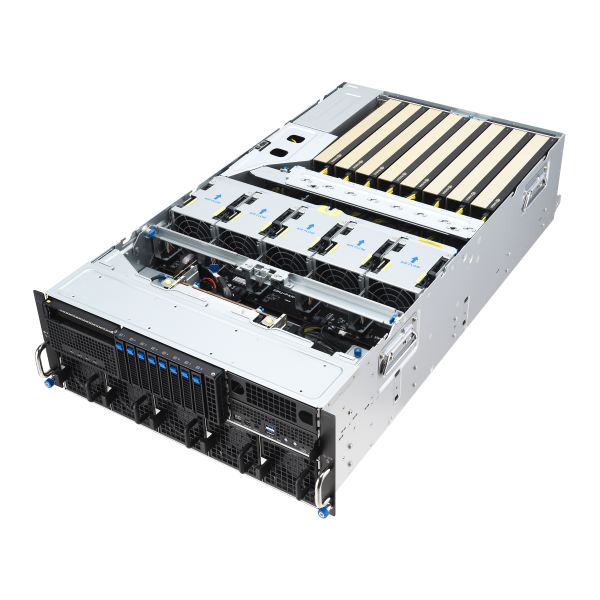
4U EPYC LLM Server
For large-model training and the biggest LLM inference workloads. Dual AMD EPYC 9005 processors with up to 8 NVIDIA GPUs, including RTX PRO 6000 Blackwell Server Edition and H200 NVL, in a 4U chassis with thermal headroom for sustained full-power operation across all GPUs.
CPU
2× AMD EPYC 9005 (up to 192C)
GPU
Up to 8 NVIDIA GPUs
Memory
Up to 3 TB DDR5 ECC
Network
Up to dual 400GbE
Starting at $39,999
Configure →
At a Glance
Is Scale the right stage for you?
| Develop | Deploy | Scale | |
|---|---|---|---|
| Audience | Individual / small team | Team-shared resource | Organization / data center |
| Form Factor | Desk-side workstation | Tower or 5U rackmount | 2U / 4U rackmount |
| GPUs | 1–2× RTX PRO Blackwell | 2–4× RTX PRO Blackwell | Up to 4 or 8 NVIDIA GPUs |
| CPU Platform | Ryzen / Threadripper PRO | Threadripper PRO 9000 WX | AMD EPYC 9005 |
| Typical Use | Prototyping, fine-tuning, data prep | Shared inference, team fine-tuning | Production inference, LLM training |
| Deployment | Under the desk | Office or first server rack | Full data center / colocation |
| Multi-Node | No | No | Up to 400 Gb networking |
| Starting Price | $4,299.99 | $13,349.99 | $13,949.99 |
3 year warranty.
Lifetime support.
Talk to the same US based engineers who built your system, for the life of the hardware.
3 Years
Parts Warranty
Lifetime
US Engineer Support
72–96h
Burn In Per Build
Scale Stage Questions
LLM servers and data center deployment, answered
Answers to the most common questions about Scale-stage LLM servers. Still have questions? Talk to our engineers.
What is an LLM server?
An LLM server is a purpose-built GPU server designed to train, fine-tune, and serve large language models at production scale. VRLA Tech's Scale-stage LLM servers are AMD EPYC rack systems with up to 4 or 8 NVIDIA GPUs, high-bandwidth ECC memory, and 24/7 data center operation, built for large-model training, high-throughput inference, and enterprise AI deployment. These systems sit above team-shared Deploy workstations in the deployment pathway and support cluster expansion for organizations scaling to multi-node training.
When should I move from Deploy to Scale?
Move to Scale when production workloads, customer-facing inference, or large-model training demand 24/7 data center operation. Common triggers include: needing 8 GPUs in a single node, multi-node cluster training, sub-second inference SLAs, regulatory requirements for dedicated infrastructure, or outgrowing Deploy-stage multi-user Threadripper PRO capacity. Scale systems drop into standard 42U racks with up to 400 Gb networking for multi-node expansion.
2U 4-GPU vs 4U 8-GPU — which should I pick?
Choose the 2U 4-GPU EPYC server for density-optimized deployments where you want maximum GPUs per rack unit and plan to run multiple nodes. Choose the 4U 8-GPU EPYC server when you need maximum GPUs per node for very large models, large-scale training, RTX PRO 6000 Blackwell Server Edition GPUs, or H200 NVL GPUs with NVLink bridges. The 4U chassis also offers better thermal headroom for sustained full-power operation across all 8 GPUs.
Why AMD EPYC 9005 instead of Intel Xeon?
AMD EPYC 9005 (Turin) delivers up to 192 cores per socket, 12-channel DDR5 ECC memory, and up to 128 PCIe 5.0 lanes per socket, enough I/O to feed 8 full-bandwidth GPUs alongside high-speed networking and NVMe storage. Intel Xeon 6 is also a strong platform, especially for workloads that use AMX, and VRLA Tech builds Intel Xeon 6 GPU servers as well. We recommend the platform that fits your workload at quote time.
What GPUs do Scale servers support?
The 4U server takes up to 8× NVIDIA RTX PRO 6000 Blackwell Server Edition (96 GB GDDR7 with ECC, passive cooling), H200 NVL (141 GB HBM3e, with NVLink bridges), L40S (48 GB), or RTX PRO 4500 Blackwell (32 GB). The 2U server takes up to 4× L40S, H100 NVL (94 GB), or RTX 5000 Ada. RTX PRO 6000 Server Edition builds always go in the 4U chassis for thermal headroom.
Can these servers run in a standard data center?
Yes. Both Scale-stage servers fit standard 19-inch 42U racks. A fully loaded 4U 8-GPU server with 8× RTX PRO 6000 Server Edition (up to 600 W each) draws up to roughly 6,000 watts and typically requires two 30A 208V circuits per node; the 4U uses 3+1 redundant 3,200 W Titanium power supplies. Rack-level considerations include rear-door heat exchangers or hot-aisle containment above 10 kW/rack, redundant 208V PDUs, and network fabric — we help customers spec the full rack and power footprint before order.
Do Scale servers support multi-node cluster training?
Yes. The 4U server is configurable with dual 25, 100, 200, or 400 Gb network adapters and the 2U with up to dual 100 Gb, for low-latency multi-node training. We can deliver multi-node clusters pre-configured with Slurm or Kubernetes and matched CUDA and NCCL versions across every node.
Do Scale systems use the same software stack as Develop and Deploy?
Yes. Every VRLA Tech system across Develop, Deploy, and Scale ships with matching NVIDIA driver, CUDA, cuDNN, TensorRT, PyTorch, and framework versions. Code and containers developed on a Develop workstation deploy to a Scale server with no rebuild, which is the primary advantage of running the full deployment pathway on a single engineering team.
What's the lead time on Scale servers?
Most VRLA Tech servers ship within 2 to 3 weeks, which includes build, 72 to 96 hour burn-in testing, thermal validation, and packaging. Multi-node cluster orders and data center GPUs depend on component availability and NVIDIA approval, and we confirm your timeline when you order.
How do Scale servers compare to Dell PowerEdge XE or HPE Cray?
VRLA Tech builds AMD EPYC rack servers to your exact workload with no locked SKUs and ships most systems within 2 to 3 weeks. Send us a competing Dell or HPE quote and our price match program will beat it or build you more server for the same budget. Every system includes lifetime US engineer support at no extra cost — you speak directly with the engineers who built your system, not through tiered support contracts.
Can I buy just one server now and add nodes later?
Yes, and most customers do exactly this. Start with one or two Scale nodes for initial production workloads, then add matched nodes as demand grows. We spec each new node to match your existing ones on CPU, GPU, memory, and networking, which keeps cluster performance consistent and Slurm scheduling simple.
What warranty and support is included?
Every VRLA Tech Scale-stage system includes a 3-year parts warranty and lifetime US-based engineer support at no extra cost. You speak directly with the engineers who built your system. If a part fails, we troubleshoot remotely first and ship the replacement part, in advance when it is in stock.
1 / 3
Ready to deploy at data center scale?Tell us your workload.
Tell us your workload.
We'll spec the cluster.
Single node or multi-node, we'll size the full rack, power, cooling, and fabric before you order.