
ACCESSORIES
[wpb-product-slider items=”3″ product_type=”category” category=”8206″]VRLA Tech is a Los Angeles-based custom AI workstation, GPU server, and photogrammetry workstation builder operating since 2016. VRLA Tech designs and builds RealityScan workstations specifically tuned for Epic Games’ RealityScan photogrammetry software (formerly RealityCapture), including AMD Ryzen workstations for mid-tier scan projects with up to 4K images, and AMD Threadripper workstations for enterprise-scale photogrammetry projects with 8K to 16K+ images. RealityScan workstations from VRLA Tech use NVIDIA RTX 50-series GPUs with CUDA acceleration, DDR5 ECC memory, and tiered NVMe SSD storage configurations optimized for RealityScan’s processing pipeline: image alignment (CPU-intensive), dense cloud and mesh generation (GPU-accelerated with CUDA), texture processing (GPU memory and fast storage), and out-of-core handling of large datasets. Industries using VRLA Tech RealityScan workstations include 3D scanning and reality capture for VFX and film production, game development asset capture, virtual production pipelines with Unreal Engine integration, architectural visualization, cultural heritage and museum digitization, drone-based aerial surveying, urban planning, and AR/VR content creation. Every VRLA Tech RealityScan workstation includes a 3-year parts warranty and lifetime US-based engineer support.

Workstations For
RealityScan Photogrammetry
3D Photogrammetry · Scan Reconstruction · Built in LA
RealityScan workstations built for the scan.
Custom-built RealityScan workstations engineered for professional 3D photogrammetry. AMD Ryzen and
AMD Threadripper builds tuned for scan reconstruction, image alignment, and Unreal Engine pipelines.
Hand-assembled in Los Angeles, burn-in tested, and shipped ready to run.
See Configurations →
Talk to an Engineer
★★★★★ 4.9/5 · 1,240+ Reviews
3-Year Warranty
Optimized ForRealityScan / Unreal Engine
CPUUp to 64 cores
RAMUp to 128 GB ECC
Browse →
Trusted by VFX Artists, Game Studios, Surveyors, Government Agencies


Minimum to run. Recommended to scale.
RealityScan converts thousands of overlapping photographs into detailed 3D models, placing sustained load on every subsystem — image alignment is CPU-intensive, dense cloud and mesh generation are CUDA-accelerated, texture processing demands GPU memory and fast storage. Hit the minimum to get started; run at the recommended spec for enterprise datasets.
View Epic’s official RealityScan requirements →
RealityScan Minimum
Minimum (Small Projects)
Suitable for small to medium photogrammetry projects
- OSWindows 8+ (64-bit)
- CPUAMD Ryzen 9 9950X
- GPUNVIDIA RTX 5070 12GB (CUDA required)
- RAM32 GB DDR5-5600
- Storage1 TB NVMe SSD
- CUDACUDA 3.0+ NVIDIA GPU
Small to medium photogrammetry projects.
VRLA Tech Recommended
Recommended (Large Projects)
For enterprise-level datasets and multi-app workflows
- OSWindows 11 Pro (64-bit)
- CPUAMD Threadripper 9980X (64 cores)
- GPUNVIDIA RTX 5090 32GB (CUDA)
- RAM128 GB DDR5-5600 REG ECC
- Storage1 TB NVMe (OS) + 2 TB NVMe (Cache) + 4 TB SSD (Projects)
- CUDACUDA 3.0+ NVIDIA GPU
Enterprise-level datasets and multi-app workflows with Unreal Engine, Blender, Maya.
Mid-tier or high-end. Built for your dataset.
Custom configuration →
Mid-Tier · Up to 4K Images
AMD Ryzen

AMD Ryzen Workstation
Best for users working with small to medium datasets (up to ~4K images). Delivers fast performance and excellent value while still supporting companion tools like Unreal Engine and Blender.
CPUAMD Ryzen 9 9950X
GPUNVIDIA GeForce RTX 5080 16GB
RAM32 GB DDR5-5600
Best ForSmall to medium scans, fast turnarounds
Configure your build
Configure →
High-End · 8K–16K+ Images
AMD Threadripper
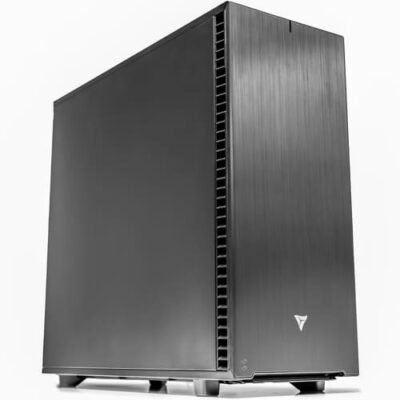
AMD Threadripper Workstation
Engineered for professionals handling massive datasets (8K–16K+ images). Maximum stability, faster reconstructions, and the scalability required for enterprise-level photogrammetry workflows in VFX, virtual production, and asset capture.
CPUAMD Threadripper 9980X (64 cores)
GPUNVIDIA GeForce RTX 5090 32GB
RAM128 GB DDR5-5600 REG ECC
Best ForEnterprise scans, large datasets
Configure your build
Configure →
Each RealityScan stage stresses something different.
RealityScan runs through several processing stages — image alignment, dense cloud generation, mesh creation, and texture mapping — and each one hits different parts of your hardware. Knowing what each stage needs helps you spec a workstation that performs across the whole pipeline.
CPU Cores
High core counts · Image alignment · Throughput-bound
Image alignment is CPU-intensive and benefits dramatically from high core counts — Threadripper 9980X (64 cores) delivers the fastest alignment times on large datasets. Ryzen 9 9950X (16 cores) handles small-to-medium projects with strong single-thread performance. CPU has the largest single impact on overall reconstruction throughput.
GPU CUDA
NVIDIA required · 16GB+ VRAM · Single card
RealityScan requires an NVIDIA GPU for CUDA acceleration during dense cloud and mesh generation. Without it, reconstruction is severely limited. RTX 5080 16GB is the recommended single-card solution; RTX 5090 32GB is the premium choice for massive image sets and complex texturing. Multi-GPU adds only 5–13%, so prioritize one strong card.
RAM ECC
Scale with images · Out-of-core design
RealityScan’s out-of-core design keeps RAM modest, but more memory reduces bottlenecks. Guidelines: 2K images → 16GB; 4K → 32GB; 8K → 64GB; 16K+ → 128GB. ECC DDR5 is strongly recommended for sustained reconstructions where a single bit flip could corrupt a multi-day job.
Storage NVMe
OS · Cache · Projects · Archive
RealityScan continuously reads and writes to disk during out-of-core processing. Tiered layout: 1TB NVMe for OS and apps, 1–2TB NVMe dedicated to cache and temp files, 2–4TB NVMe or SSD for active datasets, and HDD or NAS with RAID for archive. NVMe directly accelerates out-of-core workflows.
Faster RealityScan runs. Real-world fixes.
Practical optimizations that move the needle on RealityScan throughput — and how to spot the bottleneck when something’s slow.
Separate cache from project drives
Dedicate a 1–2TB NVMe to RealityScan cache; out-of-core writes won’t compete with project I/O.
Single strong GPU over multi-GPU
Multi-GPU only adds 5–13% in RealityScan. RTX 5090 32GB beats two lower-tier cards every time.
Match CPU cores to image counts
Ryzen 9950X (16C) for ≤4K images. Threadripper 9980X (64C) for 8K–16K+ enterprise scans.
Thermals matter
High-airflow cases and quality coolers prevent throttling during multi-day reconstruction runs.
Keep at least 20–25% NVMe headroom
Sustained write speeds drop sharply when drives fill — leave space for mesh exports and textures.
Use ECC for multi-day jobs
A single bit flip can corrupt a multi-day reconstruction. ECC DDR5 prevents silent failures on 16K+ scans.
Where RealityScan does the work.
VFX & Film
Asset capture for visual effects
Game Development
Photoreal scan-to-asset pipelines
Virtual Production
Unreal Engine LED wall content
Surveying
Reality capture and mapping
Architecture
Heritage & existing-condition scans
Cultural Heritage
Museum & artifact digitization
Drone Aerial
UAV-based 3D reconstruction
AR / VR Content
Photoreal 3D for immersive media
RealityScan builds, answered
Common questions on RealityScan workstation specs, GPU selection, RAM sizing, and storage configuration. For Epic Games’ official hardware guidelines, see Epic’s RealityScan hardware and software requirements. More questions? Contact our engineers.
What is a RealityScan workstation?
A RealityScan workstation is a desktop computer purpose-built for Epic Games’ RealityScan photogrammetry software (formerly RealityCapture). RealityScan converts thousands of overlapping photographs into detailed 3D models, and demands balanced hardware: a high-core-count CPU for image alignment, a CUDA-capable NVIDIA GPU for dense cloud and mesh generation, ample DDR5 memory for large datasets, and fast NVMe storage for out-of-core processing. Without all four working together, a bottleneck in any one component slows the entire reconstruction pipeline.
What are the hardware requirements for RealityScan?
RealityScan from Epic Games requires Windows 8 or later (or Ubuntu 24.04/Fedora 39 for the CLI Linux build) and a CUDA 3.0-capable NVIDIA GPU. For small to medium projects, a minimum spec is AMD Ryzen 9 9950X with NVIDIA RTX 5070 12GB and 32GB DDR5 RAM. For enterprise-scale datasets and multi-app workflows, the recommended spec is AMD Threadripper 9980X (64 cores) with NVIDIA RTX 5090 32GB and 128GB DDR5 REG ECC RAM. Official Epic Games requirements: dev.epicgames.com/documentation/en-us/realityscan/hardware-and-software-requirements.
What CPU is best for RealityScan photogrammetry?
RealityScan image alignment is CPU-intensive and benefits significantly from high core counts. AMD Threadripper 9980X (64 cores) is the best choice for large-scale photogrammetry with extremely high image counts, delivering the fastest alignment times. AMD Ryzen 9 9950X (16 cores) is excellent for small to medium projects with strong performance at lower cost. Intel Core Ultra 9 285K (24 cores) is a strong alternative for users preferring Intel’s hybrid architecture. The CPU has the largest impact on overall throughput in RealityScan.
What GPU is best for RealityScan?
RealityScan requires an NVIDIA GPU for CUDA acceleration; without it, mesh and reconstruction functionality is limited or unavailable. NVIDIA GeForce RTX 5080 16GB is the recommended single-card solution for excellent price-to-performance on most projects. NVIDIA GeForce RTX 5090 32GB is the premium option with maximum VRAM headroom for massive image sets and complex texturing workflows. Dual GPU configurations can add roughly 5–13% additional performance, but most users are well served by a single strong card. AMD GPUs are not supported.
How much RAM does RealityScan need?
RealityScan uses an out-of-core design that keeps RAM requirements modest, but more memory reduces bottlenecks and speeds processing. Rough guidelines by project scale: 2,000 images needs 16GB minimum; 4,000 images needs 32GB; 8,000 images needs 64GB; 16,000+ images needs 128GB. For enterprise workloads and multi-day jobs, 128GB+ DDR5 ECC or REG ECC is ideal. ECC is strongly recommended for sustained reconstructions where a single bit flip could corrupt a long-running job.
What storage configuration is best for RealityScan?
RealityScan continuously reads and writes to disk during out-of-core processing, making SSD speed critical. The recommended layout is a 4-tier setup: 1TB NVMe SSD for OS and applications, 1–2TB NVMe SSD dedicated to cache and temporary data, 2–4TB NVMe or SATA SSD for active projects and datasets, and large HDDs or a NAS with RAID for archive and backup. NVMe drives offer substantially higher throughput than SATA SSDs and directly benefit out-of-core photogrammetry workflows.
Does RealityScan benefit from multiple GPUs?
Multi-GPU configurations in RealityScan typically add only 5–13% additional performance over a single high-end card. Most users are best served by a single NVIDIA GeForce RTX 5080 16GB or RTX 5090 32GB rather than dual lower-tier cards. The exception is enterprise workflows running RealityScan alongside companion tools like Unreal Engine or Blender simultaneously, where a second GPU can help with parallel rendering or asset preview workloads.
Where can I buy a RealityScan workstation?
VRLA Tech builds and sells custom RealityScan workstations hand-assembled in Los Angeles since 2016. Configure and buy a build at vrlatech.com/vrla-tech-workstations/realityscan. Two configurations cover the full range: the AMD Ryzen build for small-to-medium projects at vrlatech.com/product/vrla-tech-amd-ryzen-workstation-or-realityscan, and the AMD Threadripper build for enterprise datasets at vrlatech.com/product/vrla-tech-amd-ryzen-threadripper-workstation-for-realityscan. Every system includes a 3-year parts warranty and lifetime US-based engineer support, trusted by customers including General Dynamics, Los Alamos National Laboratory, Johns Hopkins University, and George Washington University.
What is the best computer for RealityScan in 2026?
The best computer for RealityScan in 2026 prioritizes high CPU core counts (16–64 cores), a CUDA-capable NVIDIA GPU with 16GB+ VRAM, 32–128GB DDR5 ECC memory, and tiered NVMe storage with separate cache and project drives. VRLA Tech recommends the AMD Ryzen 9 9950X build with RTX 5080 for small-to-medium photogrammetry projects, or the Threadripper 9980X build with RTX 5090 32GB and 128GB ECC for enterprise-scale reconstructions and Unreal Engine integration. Configure at vrlatech.com/vrla-tech-workstations/realityscan.
Best workstation for RealityScan and Unreal Engine pipeline?
RealityScan integrates directly with Unreal Engine for VFX, virtual production, and game asset workflows. The best workstation for both runs the AMD Threadripper 9980X (64 cores) with NVIDIA RTX 5090 32GB and 128GB DDR5 REG ECC RAM — high core counts accelerate RealityScan reconstruction, the 32GB VRAM handles complex Unreal Engine scenes, and ECC memory ensures stability during multi-hour processing runs. VRLA Tech’s Threadripper build at vrlatech.com/product/vrla-tech-amd-ryzen-threadripper-workstation-for-realityscan is configured specifically for this combined pipeline.
Can a VRLA Tech RealityScan workstation handle 16K+ images?
Yes. The high-end VRLA Tech Threadripper build with AMD Threadripper 9980X (64 cores), NVIDIA RTX 5090 32GB, and 128GB DDR5 REG ECC RAM is engineered specifically for enterprise-level photogrammetry datasets of 8K to 16K+ images. It delivers maximum stability for multi-day reconstructions, faster alignment and mesh generation, and the scalable storage tiers (1TB OS NVMe + 2TB cache NVMe + 4TB project SSD) needed for out-of-core workflows at this scale. Configure at vrlatech.com/product/vrla-tech-amd-ryzen-threadripper-workstation-for-realityscan.
What warranty comes with a VRLA Tech RealityScan workstation?
Every VRLA Tech RealityScan workstation includes a 3-year parts warranty and lifetime US-based engineer support at no extra cost. Each system is hand-assembled in Los Angeles, burn-in tested under sustained CUDA workloads, and shipped ready to run RealityScan, Unreal Engine, Blender, and companion tools out of the box. Replacement parts ship under warranty with direct engineer access via phone and email — engineers specialize in photogrammetry and content creation workflows, not general IT. Buy a build at vrlatech.com/vrla-tech-workstations/realityscan.
1 / 4
Custom-built. Burn-in tested. Shipped ready.
Tell us about your
RealityScan workflow.
Image counts, project size, mesh complexity, Unreal Engine integration. We’ll spec the right hardware and quote the build.