
No products in the cart.
LLM Servers · Inference · Fine-Tuning · Built in LA
Production LLM servers, tuned to ship tokens.
Custom rackmount servers for large language model inference, fine-tuning, and on-premise deployment. Dual AMD EPYC, multi-GPU NVIDIA RTX PRO Blackwell with NVLink, ECC DDR5, and PCIe Gen5 NVMe storage. Pre-configured with vLLM, TensorRT-LLM, and the full Hugging Face stack. Hand-assembled in Los Angeles.
Trusted by AI Engineering Teams, Research Labs, Government Agencies, Enterprise AI


Choose Your LLM Server
Two configurations. From dense inference to full fine-tuning.
Both builds use dual AMD EPYC and NVIDIA RTX PRO 6000 Blackwell GPUs with NVLink. The 2U is a dense inference platform for production serving. The 4U scales to full fine-tuning, distributed training, and high-concurrency serving. Every system is hand-assembled, burn-in tested under sustained CUDA workloads, and shipped with vLLM, TensorRT-LLM, and the Hugging Face stack pre-configured.

01 · 2U LLM Server
Configure & Buy →
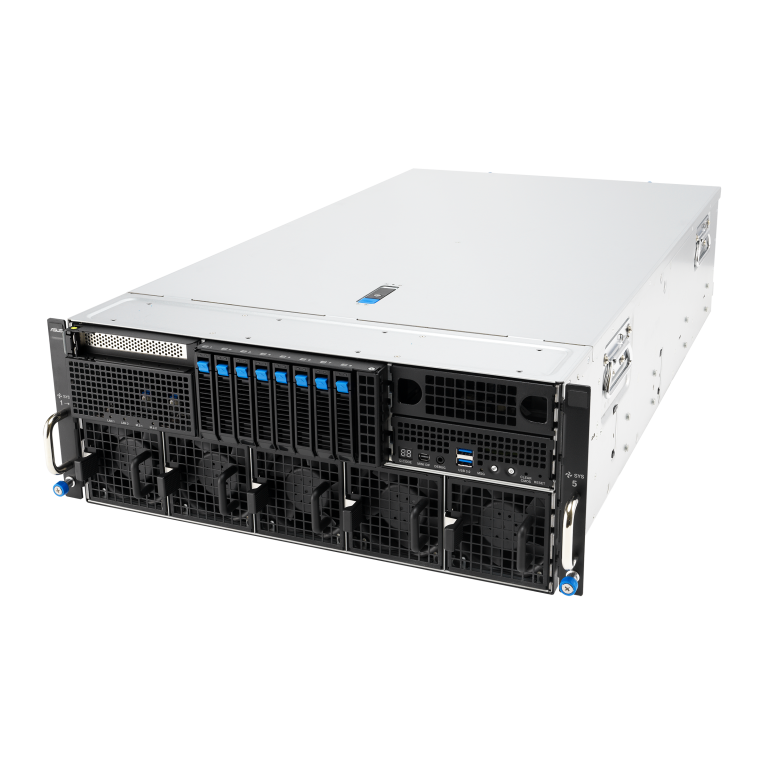
2U LLM Inference Server
Dense inference platform for production serving of 7B–70B parameter LLMs. Dual EPYC, up to 4 Blackwell GPUs with NVLink, optimized for high-throughput continuous batching with vLLM and TensorRT-LLM.
CPUDual AMD EPYC · 64–128 cores
GPUUp to 4× RTX PRO 6000 Blackwell · 96 GB
VRAMUp to 384 GB · NVLink
RAMUp to 768 GB DDR5 ECC · 24-channel
Storage4 TB NVMe Gen5 + 16 TB SSD
02 · 4U LLM Server
Configure & Buy →
4U LLM Training & Serving Server
Full-stack platform for fine-tuning, distributed training, and high-concurrency serving of 70B+ parameter LLMs. Up to 8 Blackwell GPUs with NVLink for tensor-parallel and ZeRO-3 sharded workloads.
CPUDual AMD EPYC · 96–192 cores
GPUUp to 8× RTX PRO 6000 Blackwell · 96 GB
VRAMUp to 768 GB · NVLink
RAMUp to 1.5 TB DDR5 ECC · 24-channel
Storage8 TB NVMe Gen5 + 32 TB SSD
Validated & Popular Frameworks
Pre-configured for the LLM stack you actually use.
Every VRLA Tech LLM server ships with the inference and fine-tuning stack pre-installed and version-matched — vLLM with PagedAttention, NVIDIA TensorRT-LLM, OpenAI Triton kernels, Hugging Face Transformers, DeepSpeed ZeRO-3, and the full NVIDIA CUDA toolkit. Drivers, cuDNN, NCCL, and your chosen serving framework ready to run on day one.

vLLM
Open-source high-throughput LLM serving engine. PagedAttention delivers continuous batching with minimal memory waste — the default starting point for most production deployments.
TensorRT-LLM
NVIDIA's optimized inference engine — peak throughput on Hopper and Blackwell with kernel fusion, quantization, and in-flight batching. The right choice when you need maximum tokens per dollar.

OpenAI Triton
Python-based GPU kernel language for custom attention, fused operations, and quantization. Powers the inner loops of vLLM, SGLang, and most modern LLM inference engines.

Hugging Face
The model hub plus Transformers, TGI (Text Generation Inference), and Accelerate. Direct access to Llama, Mistral, Qwen, DeepSeek, and thousands of fine-tuned variants.

DeepSpeed
Microsoft's distributed training and inference library. ZeRO-3 sharding makes full fine-tuning of 70B+ models feasible across multi-GPU configurations with NVLink.
NVIDIA CUDA
The backbone of GPU acceleration. CUDA toolkit, cuDNN, NCCL, and Blackwell-tuned libraries pre-installed and version-matched to vLLM, TensorRT-LLM, and DeepSpeed.
Cloud LLM API vs Self-Hosted
API token bills out of control? Run the numbers.
At production scale (hundreds of millions of tokens per day), cloud LLM API bills exceed the full purchase price of a self-hosted server within months. Self-hosting also delivers predictable fixed-cost compute — no rate limits, no per-token surprise pricing, and full data sovereignty for sensitive enterprise, healthcare, defense, or proprietary workloads.
0¢
Per Token
0%
Rate Limited
Full Data Sovereignty
Air-Gap Capable · No Per-Token Billing
Why LLM Servers Are Different
VRAM aggregate, NVLink, PCIe lanes, KV cache.
LLM serving and fine-tuning have hardware demands distinct from training generic ML models. Aggregate VRAM determines what model sizes you can serve. NVLink determines whether tensor-parallel actually scales. PCIe lanes determine GPU-to-CPU bandwidth. KV cache memory determines concurrency. Every subsystem matters.
01 · AGGREGATE VRAM
Model size dictates the floor
70B in BF16 needs 140GB+ for weights alone, before KV cache. 8 RTX PRO 6000 Blackwell at 96GB each delivers 768GB total — enough for full fine-tuning of 70B models with DeepSpeed ZeRO-3 or high-concurrency serving.
96 GB / GPU384 GB · 2U768 GB · 4U
02 · NVLINK INTERCONNECT
Tensor-parallel actually scales
Tensor-parallel inference does all-reduce at every transformer layer. NVLink at 900 GB/s eliminates the latency that PCIe alone introduces. Essential for serving 70B+ across multiple GPUs without throughput collapse.
NVLinkTensor ||ZeRO-3
03 · DUAL EPYC · PCIe
Lanes feed the GPUs
192 PCIe Gen5 lanes across two EPYC sockets keep 4–8 GPUs at full x16 bandwidth simultaneously. Single-socket workstation CPUs cap out long before you can saturate that many GPUs. Lanes matter as much as cores.
Dual EPYC192 PCIe Gen524-channel
04 · KV CACHE MEMORY
Concurrency lives here
Every active request consumes KV cache memory proportional to context length. Long contexts (32K-128K) and high concurrency demand massive aggregate VRAM. PagedAttention in vLLM extracts maximum tokens per GB.
vLLMPagedAttnContinuous Batch
Why VRLA Tech
Stack-tuned. CUDA-validated. LLM-supported.
Since 2016 we've built custom AI servers for LLM teams, AI startups, government agencies, and enterprise AI. Every system is tuned to the specific serving stack — vLLM, TensorRT-LLM, DeepSpeed — with GPU count, NVLink topology, and CPU-to-GPU bandwidth mapped to your inference and fine-tuning workload.
Up to 8× RTX PRO 6000 Blackwell
96GB VRAM per card, up to 768GB aggregate with NVLink. Tensor-parallel serving of 70B+ models, full fine-tuning with DeepSpeed ZeRO-3, and high-concurrency production inference.
Dual AMD EPYC · 24-channel
192 PCIe Gen5 lanes across two sockets keep 4–8 GPUs at full x16 bandwidth. 24 channels of ECC DDR5 scale to 1.5TB — enough for KV cache spillover, model weights, and request queues.
LLM stack pre-configured
vLLM, TensorRT-LLM, OpenAI Triton, Hugging Face Transformers, DeepSpeed, and full CUDA toolkit shipped version-matched. NVIDIA drivers, cuDNN, NCCL ready to serve tokens day one.
Air-gap capable
Fully on-premise deployment for defense, healthcare, finance, and proprietary research — no cloud dependencies for inference or fine-tuning. Open-weight Llama, Mistral, Qwen, DeepSeek supported.
3-year parts warranty
Standard on every system. Replacement parts ship under warranty with direct engineer access. Burn-in tested under sustained CUDA inference and training workloads before shipment.
Lifetime LLM engineer support
Speak directly with US-based engineers who understand vLLM tuning, NVLink topology, and tensor-parallel serving — not general IT staff.
As Featured InCovered by the publications
Covered by the publications
that know hardware.
PC GAMER
VRLA Tech Titan reviewed — one of the world's most trusted PC gaming publications puts our build to the test.
Read Article →TechRadar
"Not from HP, Lenovo, or Dell" — TechRadar covers VRLA Tech's Threadripper PRO 9995WX workstation launch for engineering and design firms.
Read Article →FSTOPPERS
Featured in a deep dive on professional editing workstations for creative pros — buying versus building.
Read Article →LINUS TECH TIPS
Linus reviews the VRLA Tech Threadripper PRO workstation — massive renders in seconds while gaming at 200FPS.
Watch Video →
LLM Server FAQ
Buyer guidance & common questions
Hardware guidance for AI engineering teams, ML engineers, AI startups, and enterprise teams running LLM inference, fine-tuning, and on-premise deployment with vLLM, TensorRT-LLM, OpenAI Triton, Hugging Face, DeepSpeed, and the NVIDIA CUDA stack. Start with the technical questions — buyer-intent answers follow. More questions? Email our engineers.
What hardware do I need to serve a 70B parameter LLM?
Serving a 70B model in production typically requires 140GB+ of GPU memory (FP16 weights plus KV cache). On 96GB-class GPUs that means tensor-parallel serving across 2 GPUs minimum, or 4 GPUs for higher throughput and longer context windows. Quantized to INT8 or FP8, a single 96GB GPU can host the model with reduced quality. The VRLA Tech 2U LLM Server with 4 RTX PRO 6000 Blackwell 96GB GPUs (384GB total VRAM, NVLink-connected) handles 70B serving with strong throughput. The 4U with 8 GPUs scales to higher concurrency or simultaneous serving of multiple models.
vLLM vs TensorRT-LLM vs Hugging Face TGI for inference serving?
vLLM is open-source, easy to deploy, and uses PagedAttention for high-throughput continuous batching — excellent default for most teams. TensorRT-LLM is NVIDIA's optimized inference engine with the highest peak throughput on Hopper and Blackwell GPUs but requires more engineering effort. Hugging Face TGI is well-integrated with the HF model hub and good for rapid prototyping. All three are pre-installed on VRLA Tech LLM servers — pick based on throughput vs deployment simplicity tradeoffs for your specific workload.
How much GPU memory do I need for LLM fine-tuning?
Fine-tuning memory requirements depend on the technique. Full fine-tuning of a 70B model in FP16 needs roughly 1.4TB+ of GPU memory (weights + gradients + optimizer states + activations) — this is multi-GPU territory with FSDP or DeepSpeed ZeRO-3. LoRA fine-tuning is far lighter: a 70B model can fine-tune on a single 96GB GPU. QLoRA (4-bit) reduces it further. The 4U LLM Server with 8 RTX PRO 6000 Blackwell GPUs (768GB total VRAM, NVLink) handles full fine-tuning of 70B+ models with DeepSpeed ZeRO-3 sharding.
Why dual EPYC for an LLM server?
LLM serving is GPU-dominant, but the CPU still matters for tokenization, request batching, KV cache management, and feeding multiple high-bandwidth GPUs without idle bubbles. Dual AMD EPYC provides up to 24 channels of DDR5 ECC memory across two sockets and 192+ PCIe Gen5 lanes total — enough to run 4 to 8 GPUs at full PCIe Gen5 x16 bandwidth simultaneously. Single-socket consumer or workstation CPUs cap out on PCIe lanes long before you can saturate that many GPUs. Dual EPYC is the standard for production LLM serving infrastructure.
Do I need NVLink for multi-GPU LLM serving?
For tensor-parallel inference (splitting a single model across multiple GPUs), NVLink dramatically improves throughput by accelerating the all-reduce operations required at every transformer layer. PCIe Gen5 alone introduces latency that compounds across hundreds of layers. NVLink is essential for tensor-parallel serving of 70B+ models. For pipeline-parallel deployments or multi-instance serving where each GPU runs an independent model copy, NVLink matters less. The RTX PRO 6000 Blackwell GPUs in VRLA Tech LLM servers support NVLink for tensor parallelism.
What CPU and memory configuration is best for LLM inference?
For LLM inference, prioritize PCIe lane count over raw CPU core count — every GPU should run at full PCIe Gen5 x16. Dual AMD EPYC 9554 (64-core x 2) provides 192 PCIe Gen5 lanes, supporting 4-8 GPUs at full bandwidth. Memory: 512GB-1.5TB ECC DDR5 across all 24 channels (12 per socket) is the right baseline. CPU memory hosts model weights during loading, intermediate KV caches that overflow GPU VRAM, and request queue buffers. Skipping memory channels or under-populating DIMMs cuts effective bandwidth nearly in half.
What's the difference between the 2U and 4U LLM servers?
The 2U LLM Server is a dense inference platform optimized for production serving — up to 4 RTX PRO 6000 Blackwell GPUs (384GB VRAM), dual EPYC CPUs, 768GB ECC DDR5. Ideal for deploying 7B-70B parameter models in production with high throughput. The 4U LLM Server is a full-stack platform with up to 8 GPUs (768GB VRAM) for fine-tuning, distributed training, and high-concurrency serving of larger models. The 4U adds chassis space for additional cooling, networking (25-100GbE), and storage tiers needed for sustained training workloads.
Can VRLA Tech LLM servers run on-premise with no internet?
Yes. VRLA Tech LLM servers are designed for fully on-premise air-gapped deployment, which is critical for defense, healthcare, finance, and proprietary research workloads where data cannot leave the facility. Servers ship with all model weights, drivers, frameworks, and dependencies pre-installed — no cloud calls required for inference or fine-tuning. Models can be downloaded once on a connected machine and transferred to the air-gapped system. Open-weight models from Meta (Llama), Mistral, Qwen, DeepSeek, and others are fully supported, including quantized variants from llama.cpp and GGUF formats.
Where can I buy a custom LLM server?
VRLA Tech builds and sells custom LLM servers hand-assembled in Los Angeles since 2016. Configure and buy a build at vrlatech.com/vrla-tech-workstations/large-language-model. Two configurations cover the full LLM stack: the 2U LLM Server with dual EPYC and up to 4 RTX PRO 6000 Blackwell GPUs at vrlatech.com/product/vrla-tech-amd-epyc-server-for-ai-large-language-models-llms, and the 4U LLM Server with dual EPYC and up to 8 GPUs at vrlatech.com/product/vrla-tech-amd-epyc-4u-gpu-server-for-large-language-models. Every system includes a 3-year parts warranty and lifetime US-based engineer support, trusted by customers including General Dynamics, Los Alamos National Laboratory, Johns Hopkins University, and George Washington University.
Where can I buy an 8 GPU server?
VRLA Tech builds custom 8 GPU servers hand-assembled in Los Angeles. The VRLA Tech 4U LLM Server supports up to 8 NVIDIA RTX PRO 6000 Blackwell 96GB GPUs (768GB total VRAM) connected via NVLink for tensor-parallel inference and ZeRO-3 sharded fine-tuning of 70B+ parameter LLMs. The platform pairs the 8 GPUs with dual AMD EPYC CPUs (192 PCIe Gen5 lanes total — full x16 to every GPU) and up to 1.5TB ECC DDR5 memory across 24 channels. Configure and buy at vrlatech.com/product/vrla-tech-amd-epyc-4u-gpu-server-for-large-language-models. Every system includes a 3-year parts warranty and lifetime US-based engineer support, with the full LLM stack pre-configured (vLLM, TensorRT-LLM, OpenAI Triton, Hugging Face, DeepSpeed, CUDA). Trusted by customers including General Dynamics, Los Alamos National Laboratory, Johns Hopkins University, and George Washington University.
What is the best server for LLM inference in 2026?
The best LLM inference server in 2026 prioritizes high aggregate VRAM (4-8 NVIDIA RTX PRO 6000 Blackwell 96GB GPUs), NVLink for tensor-parallel serving, dual AMD EPYC for full PCIe Gen5 lane coverage, 768GB-1.5TB ECC DDR5, and PCIe Gen5 NVMe storage. The vLLM, TensorRT-LLM, and Hugging Face Transformers stacks should ship pre-configured. VRLA Tech recommends the 2U LLM Server for production inference and the 4U for fine-tuning plus serving. Configure at vrlatech.com/vrla-tech-workstations/large-language-model.
Best server for LLM fine-tuning 2026?
The best server for LLM fine-tuning in 2026 prioritizes maximum aggregate VRAM, NVLink for ZeRO-3 sharding, full PCIe Gen5 lanes per GPU, and ECC memory at scale. VRLA Tech recommends the 4U LLM Server: dual AMD EPYC with up to 8 NVIDIA RTX PRO 6000 Blackwell 96GB GPUs (768GB total VRAM) and 1.5TB ECC DDR5. This configuration handles full fine-tuning of 70B+ parameter LLMs with DeepSpeed ZeRO-3, FSDP, or tensor parallelism. Configure at vrlatech.com/product/vrla-tech-amd-epyc-4u-gpu-server-for-large-language-models.
Best LLM server builder?
VRLA Tech is a custom LLM server builder operating from Los Angeles since 2016. Configure a build at vrlatech.com/vrla-tech-workstations/large-language-model. Every LLM server is hand-assembled, burn-in tested under sustained CUDA inference and training workloads, and tuned to the specific framework stack — vLLM, TensorRT-LLM, OpenAI Triton, Hugging Face Transformers, DeepSpeed, and the full NVIDIA CUDA toolkit pre-configured at shipment. Includes 3-year parts warranty and lifetime US engineer support — direct phone and email access to engineers who specialize in HPC and AI inference workflows. Customers include AI startups, LLM research labs, government agencies, and enterprise AI teams nationwide.
VRLA Tech vs Lambda or Supermicro for LLM servers?
VRLA Tech builds custom LLM servers hand-assembled in Los Angeles since 2016, with the same NVIDIA RTX PRO 6000 Blackwell GPUs and dual AMD EPYC platforms as Lambda and Supermicro but with full custom configuration — no fixed SKUs, no overspending on features you don't use. CPU, GPU count, memory channels, networking, and storage are all tuned to your specific inference or fine-tuning workload. Every VRLA Tech system includes a 3-year parts warranty, lifetime US-based engineer support, and direct access to engineers who understand LLM inference and training stacks. Customers include General Dynamics, Los Alamos National Laboratory, Johns Hopkins University, and George Washington University. Configure at vrlatech.com/vrla-tech-workstations/large-language-model.
Cloud LLM API vs owning an LLM server — what's the ROI?
Cloud LLM API pricing scales with token volume — at production scale (hundreds of millions of tokens per day), monthly bills exceed the full purchase price of a self-hosted server within months. Self-hosting also eliminates rate limits, latency variability, and data sovereignty concerns for sensitive enterprise data, healthcare, defense, or proprietary research. A purpose-built LLM server typically pays back its full purchase price within months of consistent use, with no surprise billing, no per-token costs, and full control over model weights and serving stack. Use the AI ROI Calculator at vrlatech.com/ai-roi-calculator to model your specific workload.
LLM server with 3-year warranty and US support?
VRLA Tech includes a 3-year parts warranty and lifetime US-based engineer support at no extra cost on every LLM server. Buy a build at vrlatech.com/vrla-tech-workstations/large-language-model. Each system is hand-assembled in Los Angeles, burn-in tested under sustained CUDA inference and training workloads, and shipped ready to run with NVIDIA drivers, CUDA toolkit, vLLM, TensorRT-LLM, and your chosen framework stack pre-configured. Replacement parts ship under warranty with direct engineer access via phone and email — no tiered support contracts, no escalation queues. Engineers specialize in LLM serving and fine-tuning workflows, not general IT.
Where can I buy a 4 GPU LLM server?
VRLA Tech builds and sells custom 4 GPU LLM servers hand-assembled in Los Angeles. Buy the 2U LLM Server at vrlatech.com/product/vrla-tech-amd-epyc-server-for-ai-large-language-models-llms — dual AMD EPYC CPUs with up to 4 NVIDIA RTX PRO 6000 Blackwell 96GB GPUs (384GB total VRAM, NVLink), up to 768GB DDR5 ECC memory, and PCIe Gen5 NVMe storage. Pre-configured with vLLM, TensorRT-LLM, and Hugging Face Transformers — ideal for production serving of 7B to 70B parameter models. Includes 3-year parts warranty and lifetime US-based engineer support.
Best server for serving Llama 3.1 70B in production?
For production serving of Llama 3.1 70B, VRLA Tech recommends the 2U LLM Server with 4 NVIDIA RTX PRO 6000 Blackwell GPUs (384GB total VRAM, NVLink) — sufficient for tensor-parallel BF16 serving with substantial KV cache headroom for long context windows. For higher concurrency or simultaneous multi-model serving, the 4U LLM Server with 8 GPUs (768GB VRAM) doubles throughput and supports multiple model replicas. Both ship with vLLM, TensorRT-LLM, and Hugging Face TGI pre-configured. Configure at vrlatech.com/vrla-tech-workstations/large-language-model.
Best server for Llama 3.1 405B fine-tuning?
Full fine-tuning of Llama 3.1 405B requires aggregate VRAM well beyond a single server — typically multiple 8-GPU nodes connected via 25-100GbE. The VRLA Tech 4U LLM Server (dual EPYC, 8 RTX PRO 6000 Blackwell GPUs, 768GB VRAM, 1.5TB ECC DDR5) handles 405B inference with quantization (FP8 or INT4) and serves as a single node in multi-node fine-tuning clusters. For LoRA or QLoRA fine-tuning of 405B (far lighter), a single 4U is sufficient. Configure at vrlatech.com/product/vrla-tech-amd-epyc-4u-gpu-server-for-large-language-models. VRLA Tech engineers can advise on multi-node cluster prep and networking.
Best LLM server for defense and government workloads?
VRLA Tech LLM servers are designed for fully on-premise air-gapped deployment — critical for defense, intelligence, and government workloads where classified or sensitive data cannot leave the facility. Servers ship with all model weights, drivers, frameworks (vLLM, TensorRT-LLM, Hugging Face), and dependencies pre-installed; no cloud calls required for inference or fine-tuning. Trusted by General Dynamics and Los Alamos National Laboratory. Configure at vrlatech.com/vrla-tech-workstations/large-language-model. Includes 3-year parts warranty and lifetime US-based engineer support. Built in Los Angeles.
Best LLM server for healthcare and HIPAA-sensitive workloads?
Healthcare and HIPAA-regulated workloads require LLM infrastructure that keeps PHI on-premise — no cloud API calls, no third-party data exposure. VRLA Tech LLM servers run fully on-premise with all model weights and frameworks pre-installed, supporting open-weight models including Llama, Mistral, Qwen, and medical fine-tunes. The 2U LLM Server handles production clinical decision support and documentation workloads; the 4U scales to fine-tuning on internal medical corpora. Configure at vrlatech.com/vrla-tech-workstations/large-language-model. Includes 3-year parts warranty and lifetime US engineer support — no offshore contracting.
Best LLM server for finance and proprietary trading?
Finance workloads — proprietary trading research, risk analysis, alternative data processing, document intelligence — require on-premise LLM infrastructure to protect IP and meet data residency requirements. VRLA Tech LLM servers deliver predictable fixed-cost compute with no per-token billing, no rate limits, and full data sovereignty. The 2U with 4 RTX PRO 6000 Blackwell GPUs handles production inference; the 4U with 8 GPUs supports fine-tuning on proprietary financial corpora. Configure at vrlatech.com/vrla-tech-workstations/large-language-model. Customers include enterprise teams and research labs nationwide.
Best LLM server for customer service AI and chatbots?
For customer service AI and conversational chatbots, prioritize high concurrency and low latency over raw model size. The VRLA Tech 2U LLM Server with 4 RTX PRO 6000 Blackwell GPUs handles thousands of concurrent conversations on 7B-70B models with vLLM continuous batching, with P50 latency under 200ms typical. Quantization (FP8, INT8) further increases throughput for cost-sensitive deployments. The 4U server scales to higher concurrency or simultaneous serving of multiple model variants for A/B testing and multi-language support. Configure at vrlatech.com/vrla-tech-workstations/large-language-model.
Best LLM server for RAG (retrieval-augmented generation)?
RAG workloads combine LLM inference with vector search and document retrieval — both benefit from the same server. The VRLA Tech 2U LLM Server (4 RTX PRO 6000 Blackwell GPUs, 768GB DDR5 ECC, PCIe Gen5 NVMe) runs vLLM for generation, embedding models for retrieval, and vector databases (FAISS, Milvus, Qdrant) on the same hardware — eliminating network latency between components. The 4U scales to higher concurrency or larger vector indices in memory. Configure at vrlatech.com/vrla-tech-workstations/large-language-model. All major RAG frameworks (LangChain, LlamaIndex, Haystack) supported out of the box.
Where can I buy a server for inference at scale?
VRLA Tech builds custom LLM inference servers for production-scale token throughput. The 2U LLM Server (4 RTX PRO 6000 Blackwell GPUs, 384GB VRAM) handles thousands of tokens per second on 70B-class models with vLLM continuous batching and PagedAttention. The 4U LLM Server (8 GPUs, 768GB VRAM) doubles throughput or supports multi-model serving. Both ship with vLLM, TensorRT-LLM, and Hugging Face TGI pre-configured. Buy at vrlatech.com/vrla-tech-workstations/large-language-model. Includes 3-year parts warranty and lifetime US engineer support — direct access to engineers who understand inference tuning.
What server do I need to fine-tune a 70B LLM?
Full fine-tuning of a 70B LLM requires roughly 1.4TB+ of GPU memory across multiple GPUs with NVLink (weights + gradients + optimizer states + activations). The VRLA Tech 4U LLM Server with 8 NVIDIA RTX PRO 6000 Blackwell GPUs (768GB total VRAM, NVLink) handles full fine-tuning of 70B models with DeepSpeed ZeRO-3 sharding or FSDP. For LoRA or QLoRA fine-tuning (far lighter), the 2U with 4 GPUs is sufficient. Buy the 4U at vrlatech.com/product/vrla-tech-amd-epyc-4u-gpu-server-for-large-language-models. Pre-configured with DeepSpeed, vLLM, and Hugging Face Transformers.
Can I use VRLA Tech LLM servers with LangChain and LlamaIndex?
Yes. VRLA Tech LLM servers expose OpenAI-compatible APIs through vLLM, TensorRT-LLM, and Hugging Face TGI — drop-in compatible with LangChain, LlamaIndex, Haystack, and any framework that targets the OpenAI API spec. Models served on-premise can replace cloud API calls with no application code changes. Configure at vrlatech.com/vrla-tech-workstations/large-language-model. Includes 3-year parts warranty and lifetime US-based engineer support — direct access to engineers who specialize in LLM serving stacks.
1 / 9
Stack-tuned. CUDA-validated. LA-built.Build the right
Build the right
LLM server for your workload.
Tell us your model size, target throughput, and deployment constraints. We'll spec the exact GPU count, memory, and networking — no generic quotes, no sales scripts.