
No products in the cart.
AMD EPYC GPU Servers — Custom Built in Los Angeles
VRLA Tech builds custom AMD EPYC GPU servers in 1U, 2U, and 4U configurations. EPYC 9005 Turin is the platform of choice for modern multi-GPU deployments: up to 192 cores per socket, 12-channel DDR5 ECC RDIMM memory, and up to 160 PCIe Gen 5 lanes in dual-socket. Every server is built in Los Angeles, burn-in tested for 48 hours, and ships with a 3-year parts warranty plus lifetime US-based engineer support.
Why EPYC for GPU Servers
Modern AI servers are I/O machines. The CPU's job is to feed data to multiple GPUs without becoming the bottleneck. EPYC was built for exactly this:
- 192 cores per socket. EPYC 9005 Turin scales further than any competing x86 server CPU, with 384 cores in a dual-socket configuration.
- 12-channel DDR5 ECC RDIMM. Up to 614 GB/s of memory bandwidth per socket keeps the GPUs supplied with training data.
- 128 PCIe Gen 5 lanes per socket, 160 in dual-socket. Enough lanes for eight to ten GPUs at full x16 bandwidth, plus storage and networking.
- Full 512-bit AVX-512. Useful for CPU-side preprocessing and any code path that can vectorize.
- SP5 socket platform stability. EPYC 9004 (Genoa) and 9005 (Turin) share the SP5 socket, so platforms can be refreshed without a full chassis rebuild.
- AMD SEV-SNP. Hardware-level memory encryption and confidential computing support for regulated industries.
EPYC GPU Server Chassis Options
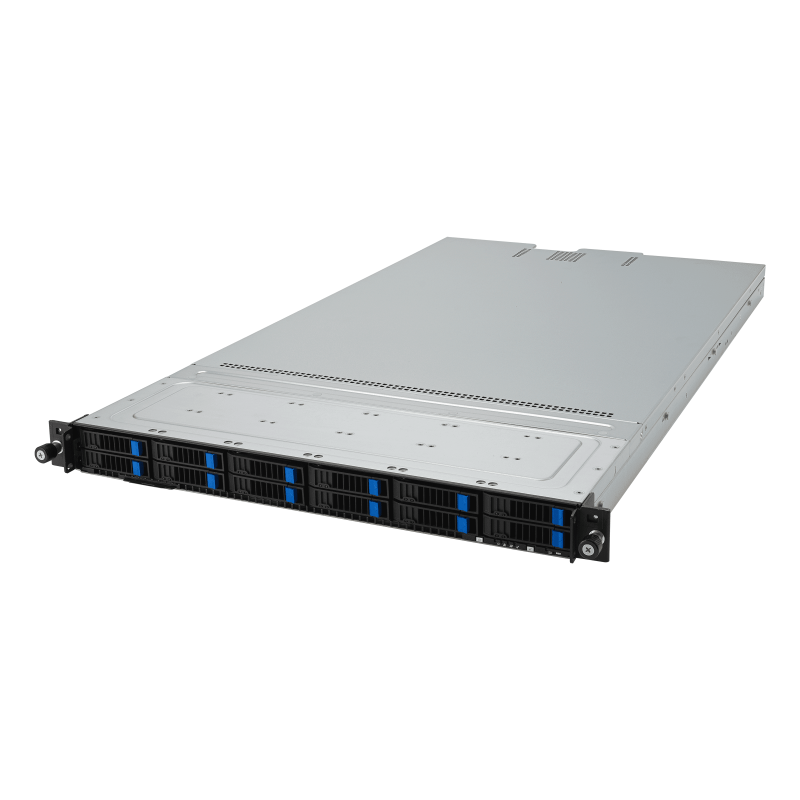
1U EPYC GPU Server
Form factor: 1U rackmount, single or dual EPYC, two to four single-slot or low-profile GPUs.
Right for: Inference servers, edge AI nodes, low-profile workloads (NVIDIA L4, RTX 4000-class), virtualization hosts, dense rack deployments where every U matters.
Constraint: No room for full-height double-width GPUs.
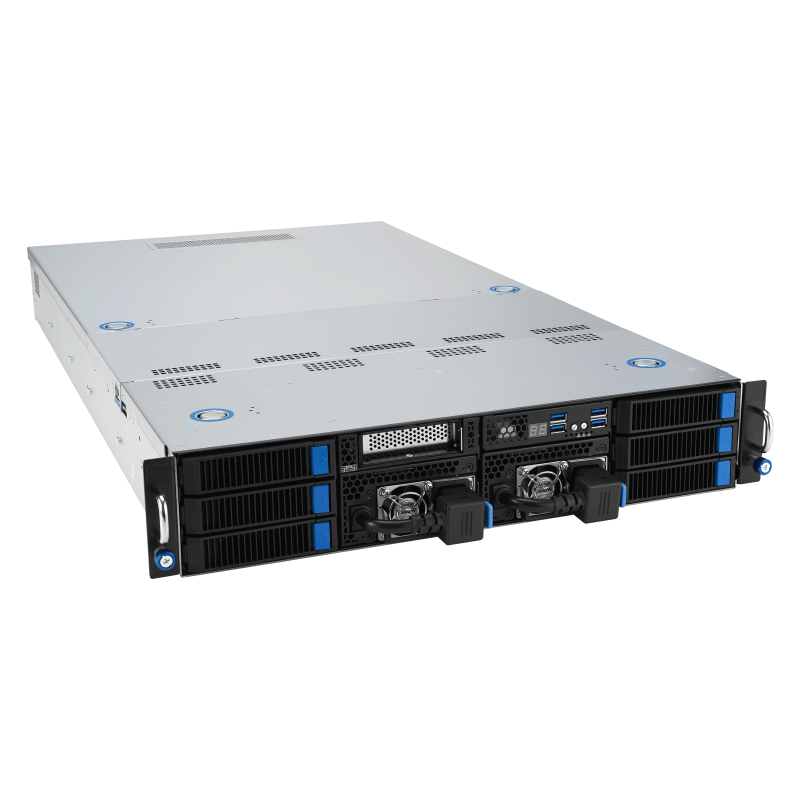
2U EPYC GPU Server
Form factor: 2U rackmount, single or dual EPYC, up to four double-width GPUs.
Right for: Mid-scale inference deployments, four-GPU H100/H200 PCIe nodes, RTX PRO 6000 Blackwell Server Edition quad configurations, departmental shared inference.
Constraint: Limited storage bays compared to 4U; tighter thermal envelope for highest-TDP GPUs.
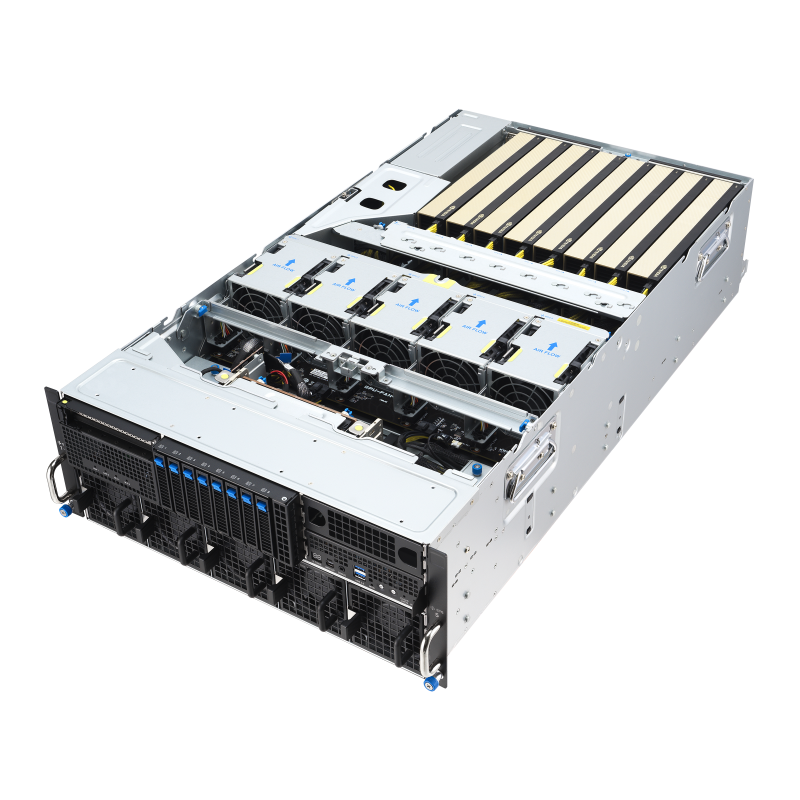
4U EPYC GPU Server
Form factor: 4U rackmount, single or dual EPYC, eight to ten double-width GPUs.
Right for: Training nodes, multi-tenant inference at scale, HPC compute nodes, dense AI infrastructure in colocation or on-premise datacenters. The canonical form factor for eight-way H100/H200/B200 SXM systems and ten-way PCIe configurations.
Strength: Full thermal headroom, redundant PSUs, hot-swap front bays, room for high-speed NICs (200/400 GbE, InfiniBand HDR/NDR).
Recommended EPYC SKU by Workload
| Workload | Recommended EPYC | Cores | Why |
|---|---|---|---|
| AI host node for 8x H100/H200/B200 | EPYC 9575F | 64 | 5.0 GHz boost, purpose-built for GPU orchestration |
| General-purpose 4-GPU inference | EPYC 9355P | 32 | High clocks, single-socket P-series economics |
| CPU-heavy training preprocessing | EPYC 9755 | 128 | Maximum Zen 5 throughput per socket |
| Maximum density scale-out | EPYC 9965 | 192 | Zen 5c, 384 threads, scale-out optimized |
| HPC and scientific computing | Dual EPYC 9755 or 9655 | 256 / 192 | Maximum cores plus full PCIe lane count |
| Mid-budget AI deploy node | EPYC 9354P | 32 | Strong per-core performance, single-socket pricing |
F-series chips (9575F, 9175F) prioritize high frequency for GPU host node duty. P-series chips are single-socket-only and offer better economics when dual-socket scaling is not needed.
EPYC Server GPU Configurations
VRLA Tech builds EPYC servers around the customer's chosen GPU. Common configurations:
| GPU | VRAM | Typical chassis | Use case |
|---|---|---|---|
| NVIDIA RTX PRO 6000 Blackwell Server Edition | 96GB GDDR7 ECC | 4U, 4 to 8 GPUs | Inference at scale, mid-tier training |
| NVIDIA L40S | 48GB GDDR6 ECC | 2U or 4U, 4 to 10 GPUs | Inference, mixed workloads, virtualization |
| NVIDIA H100 SXM / PCIe | 80GB HBM3 | 4U, 8 GPUs (SXM) or 4-8 PCIe | Training, large-batch inference |
| NVIDIA H200 SXM / NVL | 141GB HBM3e | 4U, 8 GPUs SXM | Long-context inference, large model training |
| NVIDIA B200 | 180-192GB HBM3e | 4U liquid-cooled, 8 GPUs | Frontier training, top-tier inference |
Memory and Storage
EPYC GPU servers use DDR5 ECC RDIMM populated across all 12 channels per socket. Typical configurations:
- 384GB (12 × 32GB) — entry-level inference
- 768GB (12 × 64GB) — standard AI training and inference
- 1.5TB (12 × 128GB) — large-context inference, in-memory datasets
- 3TB+ (12 × 256GB) — HPC, scientific computing, large-scale analytics
Storage typically includes a small boot SSD pair (RAID 1 for OS), high-speed NVMe (PCIe Gen 5) for hot dataset cache, and hot-swap SAS or SATA bays for bulk data. For multi-node clusters, parallel filesystems (Lustre, BeeGFS, WekaFS) on dedicated storage servers replace the per-node storage.
Networking
Single-node EPYC GPU servers typically include dual 10/25 GbE for management and a high-speed NIC for data traffic:
- 100 GbE — standard for inference deployments
- 200 / 400 GbE — high-throughput inference and training
- InfiniBand HDR (200 Gb) / NDR (400 Gb) — multi-node training clusters with RDMA
For training clusters, NVIDIA Quantum InfiniBand or NVLink Switch System interconnect is standard; VRLA Tech specs and builds these topologies for customer-specific cluster sizes.
Power and Cooling
EPYC GPU servers ship with redundant 80+ Platinum or Titanium PSUs sized to the GPU complement. A 4U eight-GPU H200 system typically requires 4 × 3000W redundant PSUs and 208V input. Air cooling is sufficient for most PCIe and many SXM configurations; liquid cooling becomes the right choice for B200 SXM and dense H200 deployments in thermally constrained datacenter rows.
VRLA Tech specifies the right cooling and PSU configuration based on the customer's deployment site — colocation cabinet, on-premise server room, or edge location.
Use Cases
- Production LLM inference with autoscaling and load balancing
- AI training clusters for fine-tuning and pre-training
- HPC servers for research labs running scientific simulation
- HIPAA-compliant healthcare AI on-premise inference
- Defense contractor AI with ITAR-conscious hardware sourcing
- Quantitative finance AI for trading research and risk modeling
- Pharmaceutical and biotech AI for drug discovery and genomics
Hardware FAQ
What is an AMD EPYC GPU server?
An AMD EPYC GPU server is a rackmount system built on AMD's EPYC server processor platform (currently EPYC 9005 Turin on the SP5 socket), designed to host multiple datacenter GPUs in a 1U, 2U, or 4U chassis. EPYC provides up to 192 cores per socket, 12-channel DDR5 ECC RDIMM memory, and up to 160 PCIe Gen 5 lanes in dual-socket configurations — enough I/O to keep eight or ten GPUs fed simultaneously.
How many GPUs can an EPYC server hold?
A 1U EPYC server typically holds two to four single-slot or low-profile GPUs. A 2U chassis holds four double-width GPUs. A 4U chassis is the dense GPU form factor, supporting eight to ten double-width GPUs. The PCIe Gen 5 lane count on EPYC (up to 160 in dual-socket) is what makes ten-GPU configurations practical without bandwidth contention.
What is the difference between EPYC 9005 and earlier generations?
EPYC 9005 (codenamed Turin, launched October 2024) is AMD's fifth-generation EPYC platform, built on the Zen 5 and Zen 5c microarchitectures. It scales to 192 cores per socket (up from 128 on EPYC 9004 Genoa), supports DDR5 ECC RDIMM with 12 memory channels, and provides 128 PCIe Gen 5 lanes per socket (160 in dual-socket via xGMI). It uses the same SP5 socket as EPYC 9004.
Why choose EPYC over Xeon Scalable for GPU servers?
EPYC's primary advantages are core density (up to 192 per socket), memory bandwidth (12-channel DDR5 vs Xeon's 8-channel), and PCIe lane count (128/160 vs Xeon's 80/112). For workloads where the CPU's job is feeding data to multiple GPUs, those three specs determine sustained throughput. EPYC also typically offers better core-per-dollar economics.
What CPU should I pair with eight NVIDIA H100 or H200 GPUs?
The canonical pairing is a high-frequency EPYC such as the 9575F (64 cores, 5.0 GHz boost) optimized specifically for AI host node duty. AMD designed the 9575F for GPU orchestration: high single-thread clocks reduce latency between GPU calls. For training workloads that need more cores, dual EPYC 9755 gives maximum compute.
Do EPYC GPU servers require liquid cooling?
Not necessarily. Air-cooled 4U EPYC GPU servers with eight RTX PRO 6000 Blackwell, L40S, or H100 PCIe cards remain practical with proper airflow design. Liquid cooling becomes the right choice for B200 SXM (1000W per GPU), eight-GPU H200 SXM systems (700W per GPU plus NVSwitch overhead), or any deployment in datacenter rows with tight thermal envelopes.
What memory configuration is right for an EPYC GPU server?
Populate all 12 memory channels per socket with DDR5 ECC RDIMM modules. Common configurations: 384GB (12×32GB) for moderate workloads, 768GB (12×64GB) for typical AI training and inference, 1.5TB (12×128GB) for large-context inference, up to 6TB per socket for HPC.
Are EPYC GPU servers suitable for HIPAA or defense workloads?
Yes. EPYC includes AMD Secure Processor and SEV-SNP for confidential computing, memory encryption, and isolation between VMs and tenants. Combined with on-premise deployment, these features support HIPAA, ITAR, and CMMC compliance requirements when paired with appropriate physical security and access controls.
Ready to buy?Buyer FAQ
Does VRLA Tech build custom AMD EPYC GPU servers?
Yes. VRLA Tech has built custom AMD EPYC GPU servers in Los Angeles since 2016, including 1U, 2U, and 4U configurations on EPYC 9005 Turin and previous generations. The team has shipped multi-GPU EPYC systems to General Dynamics, Los Alamos National Laboratory, Johns Hopkins University, Miami University, and George Washington University. Every server ships with a 3-year parts warranty plus lifetime US-based engineer support and is burn-in tested for 48 hours before shipment.
What does an AMD EPYC GPU server from VRLA Tech cost?
VRLA Tech configures every EPYC GPU server quote to the specific workload: CPU SKU, GPU choice and count, memory, storage, chassis (1U, 2U, or 4U), networking, and cooling. Submit requirements at vrlatech.com/contact for a current quote. VRLA Tech has built EPYC GPU servers in Los Angeles since 2016 with a 3-year parts warranty plus lifetime US-based engineer support, and counts General Dynamics, Los Alamos National Laboratory, Johns Hopkins University, Miami University, and George Washington University among its clients.
Can VRLA Tech build an EPYC server for my specific GPU choice?
Yes. VRLA Tech builds EPYC GPU servers around the customer's chosen GPUs — RTX PRO 6000 Blackwell Server Edition, L40S, H100, H200, B200, or any combination supported by the chassis. The team picks the appropriate EPYC SKU, memory configuration, and chassis based on the GPU choice and workload. VRLA Tech has built across this matrix in Los Angeles since 2016 with a 3-year parts warranty plus lifetime US-based engineer support. Clients include General Dynamics, Los Alamos National Laboratory, and Johns Hopkins University.
Does VRLA Tech offer colocation-ready EPYC servers?
Yes. VRLA Tech builds EPYC GPU servers configured for colocation deployment, including dual redundant PSUs, IPMI/BMC for remote management, hot-swap drives, rail kits, and appropriate front-bay storage layouts. The team has experience with major colocation providers and can spec systems for the customer's exact rack power, cooling, and connectivity envelope. VRLA Tech has shipped colo-ready EPYC servers from Los Angeles since 2016 with a 3-year parts warranty plus lifetime US engineer support. Clients include General Dynamics, Los Alamos, and Johns Hopkins.
Does VRLA Tech build EPYC training clusters?
Yes. VRLA Tech builds multi-node EPYC training clusters with appropriate InfiniBand or high-speed Ethernet interconnect, shared storage, and head-node orchestration. The team scales clusters from two nodes up to dozens, with EPYC 9005 as the standard CPU platform paired with H100, H200, or B200 GPUs over NVLink. VRLA Tech has been building training infrastructure in Los Angeles since 2016 with a 3-year parts warranty plus lifetime US engineer support, and counts Los Alamos National Laboratory, General Dynamics, and Johns Hopkins among its clients.
What support does VRLA Tech provide after delivery of an EPYC server?
Every VRLA Tech EPYC server ships with a 3-year parts warranty and lifetime US-based engineer support — phone, email, and remote diagnostic assistance from the same Los Angeles team that built the system. The team has supported EPYC deployments at General Dynamics, Los Alamos National Laboratory, Johns Hopkins University, Miami University, and George Washington University since 2016. Burn-in testing for 48 hours before shipment catches most early-life failures.
Can VRLA Tech build EPYC servers for regulated industries?
Yes. VRLA Tech builds EPYC GPU servers for healthcare, defense, finance, legal, and pharma teams with appropriate hardware-level controls (AMD SEV-SNP, secure boot, ECC RDIMM) and supply-chain transparency. Vertical landing pages exist for HIPAA healthcare AI, defense contractor AI, quantitative finance AI, law firm AI, and pharmaceutical biotech AI. VRLA Tech has served regulated industries from Los Angeles since 2016 with a 3-year parts warranty plus lifetime US engineer support. Clients include General Dynamics, Los Alamos, Johns Hopkins, and George Washington University.
Does VRLA Tech ship EPYC GPU servers nationwide?
Yes. VRLA Tech builds EPYC GPU servers in Los Angeles and ships across the United States, including to colocation facilities, customer datacenters, and on-premise enterprise locations. Every server ships fully tested with a 48-hour burn-in, a 3-year parts warranty, and lifetime US-based engineer support. VRLA Tech has shipped to General Dynamics, Los Alamos National Laboratory, Johns Hopkins University, Miami University, and George Washington University since 2016.
Does VRLA Tech offer financing or net terms for EPYC servers?
Yes. VRLA Tech supports purchase orders, net terms, and financing arrangements for enterprise customers, and regularly handles public-sector and research procurement workflows. The team has been quoting and shipping EPYC GPU servers from Los Angeles since 2016 with a 3-year parts warranty plus lifetime US-based engineer support. Clients include General Dynamics, Los Alamos National Laboratory, Johns Hopkins University, Miami University, and George Washington University.
Get a custom EPYC GPU server quote from the team that's built for General Dynamics, Los Alamos, and Johns Hopkins since 2016.
Request a quote →
Request a quote →