No products in the cart.
Purchase with confidence, 3 year warranty from the date of delivery, lifetime support
* The PC images represent various specs and upgrades. Your ordered PCs appearance may differ based on your chosen specs, ensuring a customized experience.
2-GPU AI Inference Server — Intel Xeon 6, 600W GPU, 8-Bay U.2 NVMe, 2U
The VRLA Tech 2-GPU AI Inference Server is the only 2U in…
Saw a better price somewhere?
Send us the competing quote — we'll beat it or build you something better for the same budget
Description
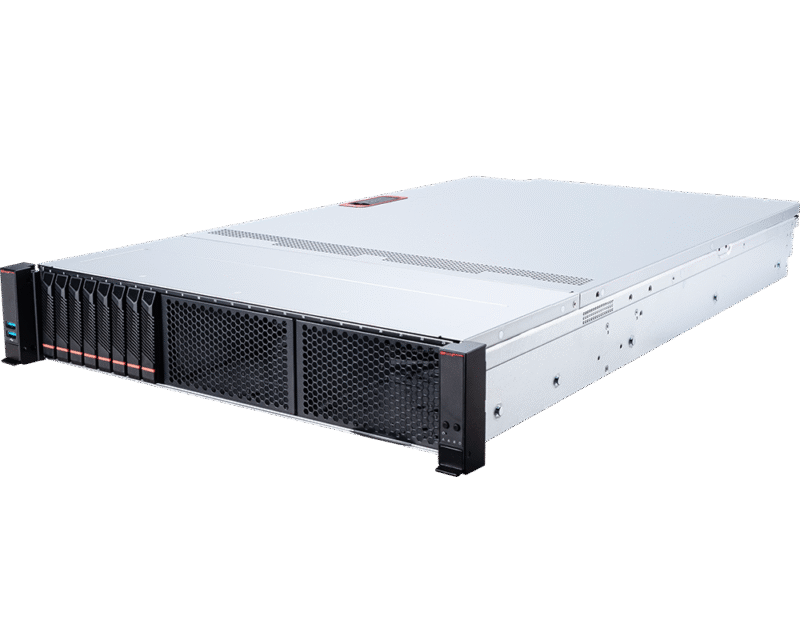
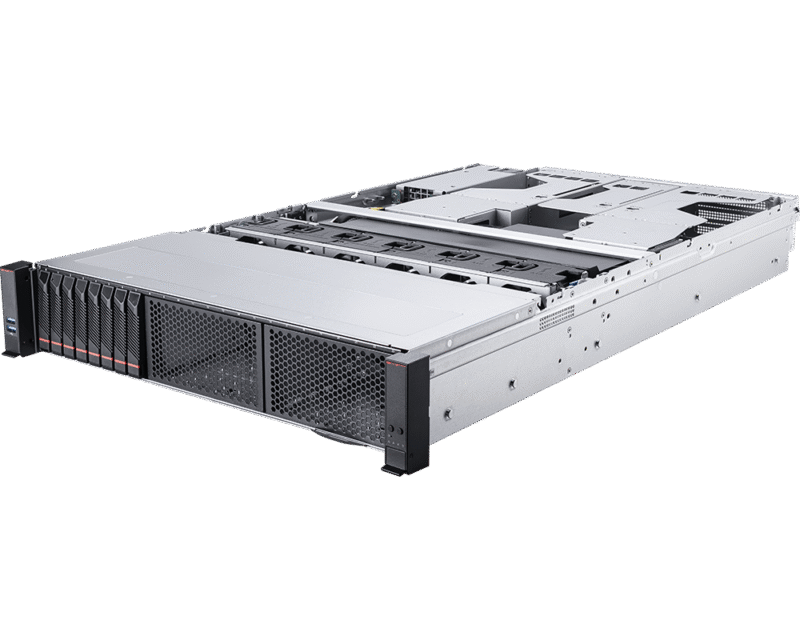
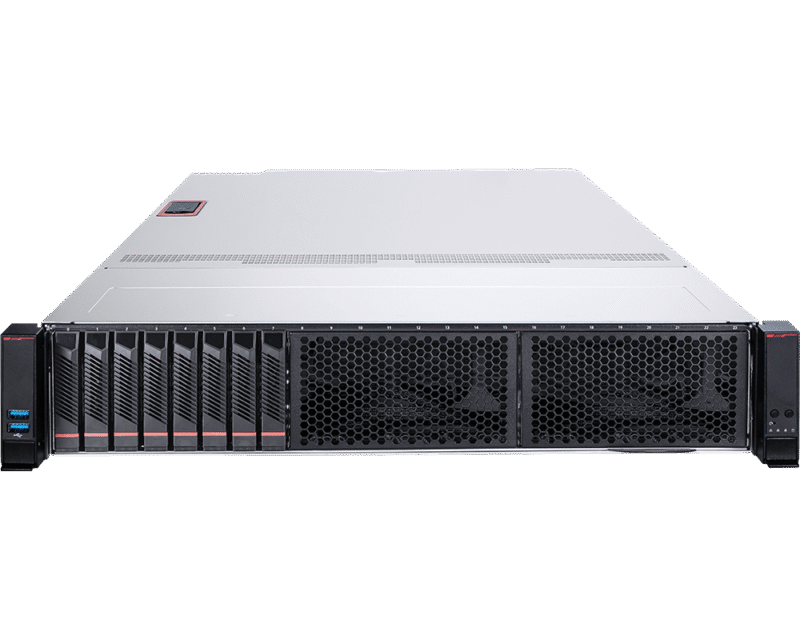
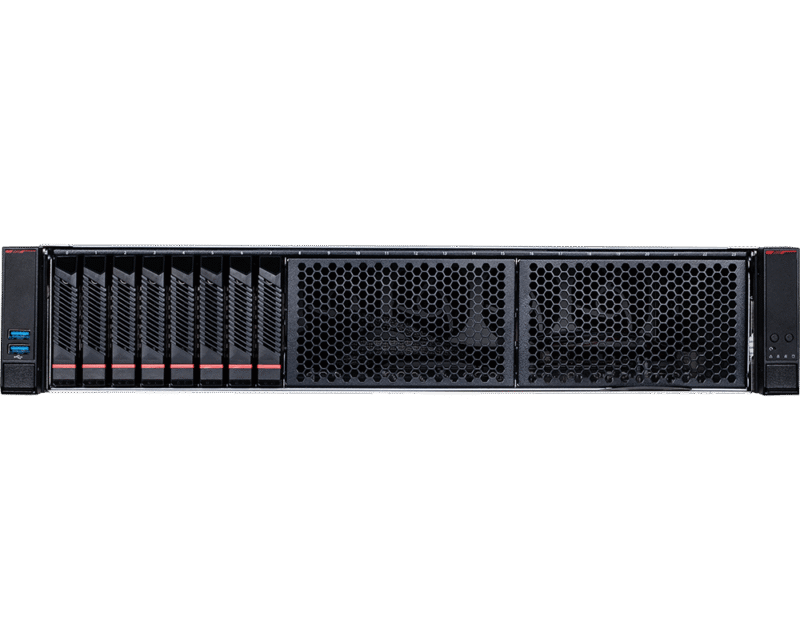
The VRLA Tech 2-GPU AI Inference Server is the only 2U in our range that takes 600W accelerators. That means two NVIDIA H200 NVL cards at 141GB HBM3e each, or two RTX PRO 6000 Blackwell Server Edition at 96GB GDDR7 — cards that will not run in a 2U chassis limited to 350W or 400W per slot. Built on the MSI CX271-S3066 (S3066X271RAU8-HE), it pairs one Intel Xeon 6 processor at up to 350W with 16 DDR5 slots supporting MRDIMM at 8000 MT/s, eight front hot-swap 2.5-inch U.2 PCIe 5.0 NVMe bays with Intel VROC RAID, four PCIe 5.0 x16 slots, dual OCP 3.0 networking, and 3,200W of 80 PLUS Titanium redundant power. Configured to your workload, built in Los Angeles, quoted within one business day, with a 3-year parts warranty and lifetime US-based engineering support.
Configuration at a glance
| Chassis | MSI CX271-S3066 (S3066X271RAU8-HE), 2U |
| CPU | One Intel Xeon 6700E, 6500P or 6700P series, up to 350W TDP |
| Socket | (1) LGA4710 (Socket E2) |
| GPU | Up to 2 × 600W double-wide — H200 NVL (141GB), RTX PRO 6000 Blackwell Server Edition (96GB), L40S (48GB), H100 PCIe (80GB) |
| Memory | (16) DDR5 slots, 8 channels (2DPC) — RDIMM to 4TB, or MRDIMM at 8000 MT/s |
| Expansion | (2) FHFL PCIe 5.0 x16 double-wide + (1) HHHL + (1) FHHL PCIe 5.0 x16 single-wide |
| Storage | (8) front hot-swap 2.5″ U.2 PCIe 5.0 x4 NVMe |
| RAID | NVMe RAID 0/1/5/10 via Intel VROC (RAID key required) |
| Networking | (2) PCIe 5.0 x16 OCP 3.0 slots (NCSI supported) |
| Management | ASPEED AST2600, IPMI 2.0, DMTF Redfish, dual BIOS & dual BMC |
| Security | Chassis intrusion; optional TPM 2.0 and ASPEED AST1060 root of trust |
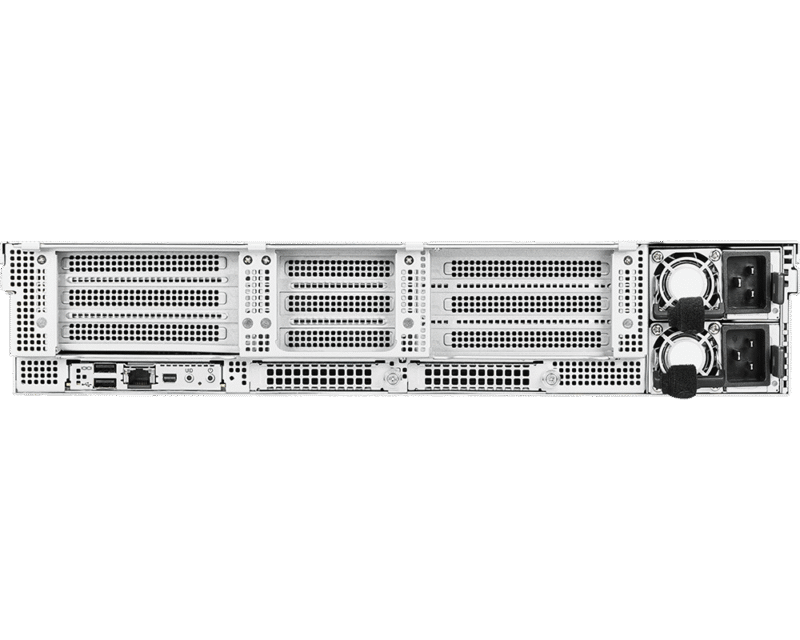
| Power | (1+1) redundant 3,200W CRPS, 80 PLUS Titanium |
| Warranty | 3-year parts, lifetime US-based engineering support |
The 2U that takes the cards nobody else’s 2U will
Why this platform exists
Two 600W accelerators in 2U. An H200 NVL draws 600W. An RTX PRO 6000 Blackwell Server Edition has a practical floor of 450W, set by its power cable’s sense pins. Most 2U GPU servers cap each slot at 350W or 400W, which rules both cards out entirely — not throttled, not supported. This chassis powers two of them, backed by 3,200W of Titanium-rated redundant supply. Two H200 NVLs give you 282GB of HBM3e in two rack units.
If you have been told your accelerator will not fit a 2U, this is the machine that changes the answer. It is the only platform in our 2U range rated for 600W per slot — our AMD EPYC 2U tops out at 400W per card, which excludes the H200 NVL and the Server Edition. For more than two accelerators, the 8-GPU 4U platform is the next step up.
Beyond the GPUs, this is an Intel platform in a lineup that is otherwise AMD — which matters if your estate is standardized on Intel, if you need AMX for CPU-side inference, or if MRDIMM bandwidth is worth more to you than raw memory capacity. Browse the full VRLA Tech server range, or if the workload fits under a desk rather than in a rack, see our AI and HPC workstations. Request a quote and we will reply within one business day.
What you get that the AMD platforms don’t
Four Intel-specific advantages
- 600W per GPU slot. The headline. Two double-wide PCIe 5.0 x16 slots rated to 600W each, which covers every PCIe accelerator NVIDIA currently ships — H200 NVL, RTX PRO 6000 Blackwell Server Edition at full power, L40S, H100 PCIe. Cards above 400W require 25°C ambient; see the deployment note below.
- Intel AMX for CPU-side inference. Advanced Matrix Extensions is a matrix-multiplication engine built into Xeon 6 performance cores, accelerating the same tensor math that dominates neural network inference — on the CPU, with no accelerator involved. For smaller models, embedding generation, preprocessing, and spillover when GPU memory saturates, the processor does real inference work instead of just feeding the GPUs. AMD EPYC has no equivalent.
- MRDIMM at 8000 MT/s. The fastest per-channel memory in anything we build. Multiplexed rank DIMMs run at 8000 MT/s against 6400 for standard RDIMM, at one DIMM per channel, on performance-core processors. Where per-channel bandwidth drives your runtime rather than total capacity, this is the configuration to ask for.
- Integrated NVMe RAID. Intel VROC provides RAID 0, 1, 5 and 10 across the eight U.2 bays with a VROC key — redundancy without surrendering a PCIe slot to a hardware controller. Our AMD EPYC platforms have no integrated NVMe RAID at all.
And what the platform shares with the rest of the range
- All-flash PCIe Gen 5 storage. Eight front hot-swap 2.5-inch bays, every one U.2 PCIe 5.0 x4 NVMe. No SATA compromise, no shared bandwidth.
- Two spare expansion slots after the GPUs. One HHHL and one FHHL PCIe 5.0 x16 single-wide slot stay free for a DPU, an HBA, or a capture card — and because networking lives on the two OCP 3.0 mezzanine slots, a NIC never costs you an expansion slot.
- Enterprise resilience and platform integrity. Dual BIOS and dual BMC, ASPEED AST2600 with IPMI 2.0 and DMTF Redfish on a dedicated management port, chassis intrusion detection, and optional TPM 2.0 plus ASPEED AST1060 hardware root of trust for supply-chain assurance.
GPU options
Both double-wide PCIe 5.0 x16 slots accept full-height, full-length cards rated up to 600W each.
| GPU | Memory | TDP | Cooling | Combined VRAM |
|---|---|---|---|---|
| NVIDIA H200 NVL | 141GB HBM3e | 600W | Passive | 282GB |
| RTX PRO 6000 Blackwell Server Edition | 96GB GDDR7 ECC | 450–600W | Passive | 192GB |
| RTX PRO 6000 Blackwell Max-Q | 96GB GDDR7 ECC | 300W | Blower | 192GB |
| NVIDIA H100 PCIe | 80GB HBM2e | 350W | Passive | 160GB |
| NVIDIA L40S | 48GB GDDR6 | 350W | Passive | 96GB |
| NVIDIA L4 | 24GB GDDR6 | 72W | Passive, 1-slot LP | 48GB |
Deployment requirements for 600W cards
Ambient temperature. MSI rates the chassis 10°C to 35°C, but specifies that cards above 400W are supported at 25°C operating temperature. A 600W configuration needs a cool aisle. Above 25°C, plan for 400W-class accelerators instead.
Input voltage. The 3,200W supplies deliver up to 1,300W on 100–127V, 3,000W on 200–220V, and the full 3,200W only on 220–240V. Two 600W GPUs plus a 350W processor is roughly 1,550W before memory, drives and fans, so 600W configurations require 220–240V. C19 cords are required and sold separately.
Processor dependency. MSI notes that one of the two double-wide slots, and the OCP1 networking slot, operate only with a qualifying processor. We confirm the CPU and GPU pairing with MSI before quoting a two-card configuration.
Model capacity
Figures are weight footprint only. KV cache is additional and scales with context — a 70B model needs roughly 2.6GB at 8K context and around 41GB at 128K on top of the weights. We size every deployment against its real context length and concurrency target.
| Model | Precision | Approx. weights | 2× H200 NVL (282GB) | 2× RTX PRO 6000 SE (192GB) |
|---|---|---|---|---|
| Llama 3.3 70B | FP8 | ~70GB | Yes — high concurrency | Yes — high concurrency |
| Llama 3.3 70B | FP16 | ~140GB | Yes | Yes — tight |
| Qwen3 235B-A22B (MoE) | INT4 | ~120GB | Yes | Yes |
| Llama 3.1 405B | INT4 | ~203GB | Yes | No |
| DeepSeek-R1 671B | Q4 | ~370GB | No — 4U platform | No — 4U platform |
Mixture-of-experts models load every expert into memory regardless of active parameter count — size against total parameters. Our full reference is at LLM VRAM Requirements 2026.
Full technical specifications
| Chassis | MSI CX271-S3066 (S3066X271RAU8-HE) |
| Form factor | 2U rackmount |
| Dimensions | 438mm (17.2″) W × 87mm (3.4″) H × 764mm (30″) D |
| Processor | One Intel Xeon 6700E, 6500P or 6700P series, TDP up to 350W |
| Socket | (1) LGA4710 (Socket E2) |
| Memory | (16) DDR5 DIMM slots, 8 channels, 2 DIMMs per channel — RDIMM, RDIMM-3DS, MRDIMM RDIMM (6500P/6700P): 6400 MT/s 1DPC, 6000 MT/s 2DPC · RDIMM (6700E): 6400 MT/s 1DPC, 5200 MT/s 2DPC MRDIMM: 8000 MT/s, 1DPC only, performance-core processor required Max 256GB per RDIMM, 64GB per MRDIMM |
| Drive bays | (8) front hot-swap 2.5″ U.2 PCIe 5.0 x4 NVMe |
| Expansion slots | (2) FHFL PCIe 5.0 x16 double-wide, up to 600W per card (1) HHHL PCIe 5.0 x16 single-wide · (1) FHHL PCIe 5.0 x16 single-wide One double-wide slot requires a qualifying processor |
| GPU support | Up to (2) GPUs in the double-wide slots, up to 600W each Cards above 400W supported at 25°C operating temperature |
| Networking | (2) PCIe 5.0 x16 OCP 3.0 slots, NCSI supported (one NCSI slot active at a time) OCP1 slot requires a qualifying processor |
| RAID | NVMe RAID 0/1/5/10 via Intel VROC (VROC RAID key required) |
| Front I/O | (8) hot-swap U.2 bays, (2) USB 3.0 Type-A, system power LED button, UID LED button, reset button, (4) status LEDs (Fault/LAN/M.2) |
| Rear I/O | (1) dedicated 1000Base-T management port, (1) COM USB Type-A, (1) USB 2.0 Type-A, (1) Mini DisplayPort, power and UID LED buttons, status LEDs |
| Server management | ASPEED AST2600 with AMI MegaRAC firmware, IPMI 2.0 and DMTF Redfish API, dual BIOS, dual BMC, eMMC BMC storage, dedicated 1000Base-T management port |
| Security | Chassis intrusion detection; optional TPM 2.0 module; optional ASPEED AST1060 root of trust module |
| Power supply | (1+1) redundant 3,200W CRPS, 80 PLUS Titanium 100–127VAC: up to 1,300W · 200–220VAC: up to 3,000W · 220–240VAC or 240VDC: up to 3,200W C19 power cords required (sold separately) |
| Cooling | (1) EVAC air cooling module for processors up to 350W, (6) hot-swap 6056 system fans |
| Environment | Operating 10°C to 35°C, 8% to 85% humidity non-condensing Non-operating −30°C to 60°C, 8% to 90% humidity non-condensing |
| Certification | CE, FCC Class A |
| OS support | Windows Server 2025, Ubuntu 24.04, Red Hat Enterprise Linux 9.0, Rocky Linux 8.10 / 9.7 / 10.1 |
Intel Xeon 6 or AMD EPYC?
We build both and have no preference. The honest decision rule:
| This platform — Intel Xeon 6 | AMD EPYC 2U | |
|---|---|---|
| GPU power per slot | 600W | 400W |
| H200 NVL / RTX PRO 6000 SE | Supported | Exceeds slot limit |
| Max memory | 4TB | 6TB |
| Memory channels | 8 | 12 |
| Fastest memory | MRDIMM 8000 MT/s | RDIMM 5200 MT/s |
| Max cores | 144 (E-core) / 86 (P-core) | 192 |
| CPU AI acceleration | AMX | None |
| NVMe RAID | Intel VROC 0/1/5/10 | Not integrated |
| Expansion slots | 4 PCIe + 2 OCP | 3 PCIe + 2 OCP |
Choose Intel when you need 600W accelerators in 2U, when AMX helps your CPU-side inference, when MRDIMM bandwidth matters more than capacity, when you want integrated NVMe RAID, or when your estate is standardized on Intel. Choose AMD when you need more than 4TB of memory, more than 86 performance cores, or 12 memory channels. Tell us the workload and we will size it honestly either way.
What you configure
- Processor. One Intel Xeon 6 part up to 350W. 6700P and 6500P performance-core parts to 86 cores, with AMX for CPU-side inference and MRDIMM support — the default choice for AI work. 6700E efficiency-core parts to 144 cores for throughput-dense, cloud-native and containerized workloads where core count beats per-core performance.
- Accelerators. Up to two double-wide cards at 600W. H200 NVL for maximum VRAM and HBM3e bandwidth. RTX PRO 6000 Blackwell Server Edition for 96GB per card at lower cost per gigabyte. L40S for cost-optimized inference and mixed AI-plus-graphics. H100 PCIe for established Hopper pipelines. L4 for lightweight inference and video.
- Memory. Sixteen slots across eight channels. RDIMM to 4TB at 6400 MT/s, or MRDIMM at 8000 MT/s for maximum per-channel bandwidth. We will tell you which fits your workload rather than selling you the larger number.
- Storage. Eight front hot-swap U.2 PCIe Gen 5 bays, with Intel VROC NVMe RAID 0/1/5/10 available via RAID key. Enterprise NVMe sized to your dataset.
- Networking. Two OCP 3.0 mezzanine slots from 10GbE through 400GbE, leaving all four PCIe slots free. At least one adapter is specified in every configuration, not treated as an upsell.
- OS and software. Pre-loaded with Ubuntu Server 24.04 LTS plus CUDA and NVIDIA drivers, Red Hat Enterprise Linux 9, Rocky Linux, or Windows Server 2025. Deployed and supported for vLLM, NVIDIA Triton Inference Server, TensorRT-LLM, SGLang, Ollama and Hugging Face TGI, and for Milvus, Qdrant, Weaviate and pgvector on the retrieval side.
Workloads we build this server for
- Production LLM inference. Serving open-weight models to internal users or customer-facing applications. Two H200 NVLs give 282GB of HBM3e — enough for a 405B model at INT4, or a 70B at FP8 with heavy concurrency. vLLM, Triton, TensorRT-LLM, SGLang, Ollama, Hugging Face TGI.
- Mixed CPU and GPU inference pipelines. AMX lets the processor run smaller models, embedding generation and preprocessing without touching the GPUs, so the accelerators stay dedicated to the large model. The strongest argument for this platform over an AMD equivalent.
- Retrieval-augmented generation and vector search. Vector index in memory, corpus on eight Gen 5 NVMe bays with VROC redundancy, GPUs handling embedding and serving. Milvus, Qdrant, Weaviate, pgvector, Elasticsearch, LlamaIndex, LangChain.
- Model fine-tuning. LoRA, QLoRA and parameter-efficient adaptation on two high-VRAM accelerators. Full-parameter training of large models belongs on the 8-GPU 4U platform.
- Virtualization with GPU passthrough. Multi-tenant inference under Proxmox VE, VMware or KVM, with VROC-protected NVMe underneath and MIG partitioning on supported cards.
- Cloud computing and content delivery. Multi-tenant compute and edge caching, where core count, all-flash Gen 5 storage and dual high-speed OCP adapters carry the load.
Industry applications
- Defense and government. Air-gapped and classified inference where a commercial API is prohibited. Optional TPM 2.0 and AST1060 hardware root of trust, dual BIOS and dual BMC, isolated management. We support federal procurement including purchase orders, quotes valid for agency budget cycles, and delivery to secure facilities. Customers include General Dynamics and Los Alamos National Laboratory. More on our defense and government systems.
- Healthcare and life sciences. On-premises inference over protected health information without third-party data processing agreements. Clinical documentation, literature retrieval and imaging pipelines under HIPAA. Customers include Johns Hopkins University. More on our healthcare AI systems.
- Legal. Document review, contract analysis and case research over privileged material that cannot be uploaded to a third-party model provider. More on our systems for law firms.
- Financial services. Trading research, risk modeling and document analysis under data residency and audit requirements, with deterministic latency rather than shared-tenancy variability. More on our quantitative research and finance systems.
- Research and higher education. Departmental inference against grant cycles rather than variable cloud spend. Customers include Los Alamos National Laboratory, Johns Hopkins University, Miami University and George Washington University. Education and research pricing available. More on our HPC servers for research labs.
- Pharmaceutical. Molecular property prediction, literature mining and internal knowledge retrieval over proprietary research data. More on our pharma and biotech systems.
Why buy from VRLA Tech
VRLA Tech has built custom workstations, GPU servers and rack servers in Los Angeles since 2016. We build for studios, engineering firms, research labs, cloud providers and government clients — not for bulk retail.
Our enterprise clients include
- General Dynamics
- Los Alamos National Laboratory
- Johns Hopkins University
- Miami University
- George Washington University
Quotes come back within one business day. Every system ships with a 3-year parts warranty and lifetime US-based engineering support, and you talk to the same engineer who built your system if something goes wrong — remote diagnostics, BMC and IPMI assistance, BIOS and firmware updates, NVIDIA driver and CUDA help, inference engine deployment support, and component-level repair. Every system is burn-in tested and thermally validated before shipping, and every 600W GPU configuration ships with a written power and thermal report against your site conditions. Weighing this against cloud GPU rental? Run the numbers with our AI ROI calculator.
Frequently asked questions
Hardware & platform questions
What 2U server fits an NVIDIA H200 NVL?
The VRLA Tech 2-GPU AI Inference Server on Intel Xeon 6 accepts two NVIDIA H200 NVL cards at 600W each in a 2U chassis, giving 282GB of combined HBM3e memory. Most 2U GPU servers cap at 350W or 400W per slot and cannot take an H200 NVL at all. This platform supports cards up to 600W in both double-wide PCIe 5.0 x16 slots, with 3,200W of 80 PLUS Titanium redundant power behind them. Cards above 400W require a 25°C ambient operating temperature.
Can I run two RTX PRO 6000 Blackwell Server Edition cards in a 2U server?
Yes. This 2U platform supports two 600W double-wide cards, which covers the RTX PRO 6000 Blackwell Server Edition across its full 450W to 600W configurable range. Two cards deliver 192GB of combined GDDR7 ECC memory. Many 2U chassis limit each slot to 400W, which excludes the Server Edition entirely because its practical floor is 450W — the power cable sets that limit through its sense pins. We validate the specific GPU pairing and supply a written thermal and power report before every build.
Which GPUs does this 2U Intel Xeon 6 server support?
Two double-wide PCIe 5.0 x16 slots accept cards up to 600W each. Supported accelerators include the NVIDIA H200 NVL at 141GB HBM3e and 600W, RTX PRO 6000 Blackwell Server Edition at 96GB GDDR7 ECC and 450 to 600W configurable, NVIDIA L40S at 48GB and 350W, NVIDIA H100 PCIe at 80GB HBM2e and 350W, RTX PRO 6000 Blackwell Max-Q at 96GB and 300W, and NVIDIA L4 at 24GB and 72W. Cards above 400W are supported at 25°C operating temperature. Two further single-wide PCIe 5.0 x16 slots remain available for DPUs, HBAs or additional network adapters.
What is Intel AMX and why does it matter for AI inference?
Intel Advanced Matrix Extensions is a dedicated matrix-multiplication engine built into Xeon 6 performance-core processors. It accelerates the same tensor operations that dominate neural network inference, directly on the CPU, without an accelerator. For smaller models, embedding generation, batch preprocessing, and spillover when GPU memory is saturated, AMX lets the processor carry real inference work rather than only feeding the GPUs. AMD EPYC has no equivalent instruction set, which makes an Intel Xeon 6 platform the stronger choice for pipelines that mix CPU and GPU inference.
How much memory and what memory speed does this server support?
Sixteen DDR5 DIMM slots across eight channels at two DIMMs per channel, supporting RDIMM, RDIMM-3DS and MRDIMM. With RDIMM at up to 256GB per module the platform reaches 4TB. Standard RDIMM runs at 6400 MT/s at one DIMM per channel and 6000 MT/s at two on 6500P and 6700P processors. MRDIMM runs at 8000 MT/s but is limited to one DIMM per channel, 64GB per module, and requires a performance-core processor. MRDIMM is the fastest per-channel memory available in any server we build.
Does this server support NVMe RAID?
Yes. The platform supports NVMe RAID 0, 1, 5 and 10 through Intel VROC, which requires a VROC RAID key. This means redundancy across the eight front hot-swap U.2 PCIe 5.0 x4 NVMe bays without consuming a PCIe slot on a hardware RAID controller. Our AMD EPYC platforms do not offer integrated NVMe RAID, so this is a meaningful difference for deployments that need protected NVMe storage in a single node.
What processors does this Intel Xeon 6 server support?
One Intel Xeon 6 processor from the 6700E, 6500P or 6700P series on Socket E2 (LGA4710), up to 350W TDP. The 6700E Sierra Forest efficiency-core parts scale to 144 cores for throughput-dense and cloud-native workloads. The 6500P and 6700P Granite Rapids performance-core parts reach 86 cores and include AMX for CPU-side AI inference and AVX-512, and are required for MRDIMM memory. We size processor selection against the specific workload rather than defaulting to core count.
What power does a 600W dual-GPU 2U server require?
This platform uses 1+1 redundant 3,200W CRPS 80 PLUS Titanium supplies, and output depends on input voltage: up to 1,300W on 100–127V, up to 3,000W on 200–220V, and the full 3,200W on 220–240V or 240VDC. Two 600W GPUs and a 350W processor draw roughly 1,550W before memory, drives and fans, so any 600W GPU configuration requires 220–240V power. C19 cords are required and sold separately. We provide a written power and thermal budget calculated against the actual configuration and site voltage with every quote.
Should I buy an Intel Xeon 6 or AMD EPYC inference server?
Choose Intel Xeon 6 when you need 600W accelerators in 2U, when AMX matters for CPU-side inference, when MRDIMM bandwidth at 8000 MT/s helps, or when your estate is standardized on Intel. Choose AMD EPYC when you need more memory capacity — our EPYC 2U platforms reach 6TB against 4TB here — more memory channels, or higher core counts than 86 performance cores. We build both and size the decision against the actual workload rather than the platform.
Ready to buy?
Buying & vendor questions
Where can I buy an H200 server in the United States?
VRLA Tech builds custom H200 servers in Los Angeles, configured to the specific workload and hand-assembled in the United States since 2016. This 2U Intel Xeon 6 platform takes two H200 NVL cards at 600W each for 282GB of combined HBM3e; the 4U platform scales to eight accelerators. Every system ships with a 3-year parts warranty and lifetime US-based engineering support, and quotes are returned within one business day. Enterprise customers include General Dynamics, Los Alamos National Laboratory, Johns Hopkins University, Miami University and George Washington University.
What is the best 2U server for LLM inference?
The right 2U inference server is decided by how much VRAM your model needs and whether the chassis can power the cards that provide it. This platform takes two 600W accelerators — H200 NVL at 141GB each or RTX PRO 6000 Blackwell Server Edition at 96GB each — which covers models up to roughly 405 billion parameters at INT4. It pairs them with an Intel Xeon 6 processor with AMX for CPU-side inference, eight PCIe Gen 5 U.2 NVMe bays, and MRDIMM memory at up to 8000 MT/s. Chassis limited to 350W or 400W per slot cannot run the highest-VRAM cards at all.
Best company to buy a custom Intel Xeon 6 GPU server from?
VRLA Tech builds custom Intel Xeon 6 GPU servers in Los Angeles, configured to the workload and hand-assembled in the United States since 2016. This 2U platform pairs a Xeon 6 processor with two 600W accelerators, up to 4TB of DDR5 or MRDIMM at 8000 MT/s, eight PCIe Gen 5 U.2 NVMe bays with Intel VROC RAID, and dual OCP 3.0 networking. Quotes are returned within one business day. Every system ships with a 3-year parts warranty and lifetime US-based engineering support, and customers work directly with the engineer who built their system.
Where can I buy an on-premise LLM inference server for air-gapped or classified work?
VRLA Tech builds on-premises inference servers for air-gapped and classified environments, where sending data to a commercial API is prohibited. This platform supports an optional TPM 2.0 module and an optional ASPEED AST1060 hardware root of trust, with dual BIOS and dual BMC for firmware resilience, chassis intrusion detection, and management isolated on a dedicated port. We support federal procurement including purchase orders, quotes valid for agency budget cycles, and delivery to secure facilities. Customers include General Dynamics and Los Alamos National Laboratory.
Custom AMD and Intel 2U rack server builders with warranty and US support?
VRLA Tech builds custom Intel Xeon and AMD EPYC 2U rack servers with a 3-year parts warranty and lifetime US-based engineering support. Customers work directly with the engineer who built their system. Support includes remote diagnostics, BMC and IPMI assistance, BIOS and firmware updates, NVIDIA driver and CUDA assistance, inference engine deployment support, and component troubleshooting. Quotes are returned within one business day. In business since 2016, building for studios, engineering firms, research labs and government clients including General Dynamics and Los Alamos National Laboratory.