No products in the cart.
Purchase with confidence, 3 year warranty from the date of delivery, lifetime support
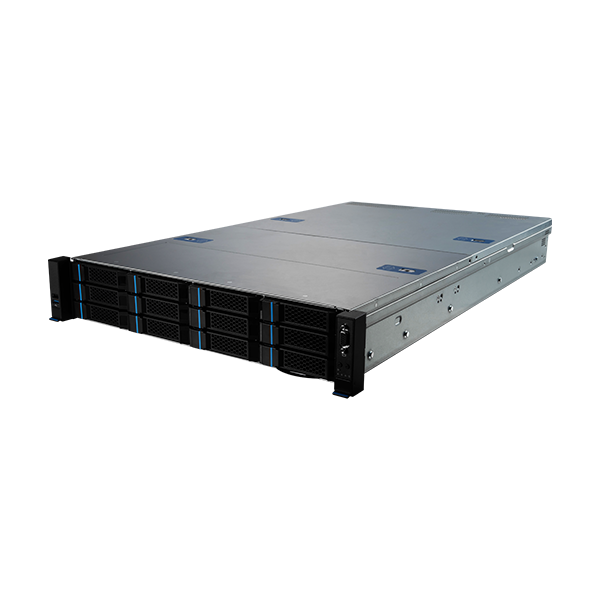
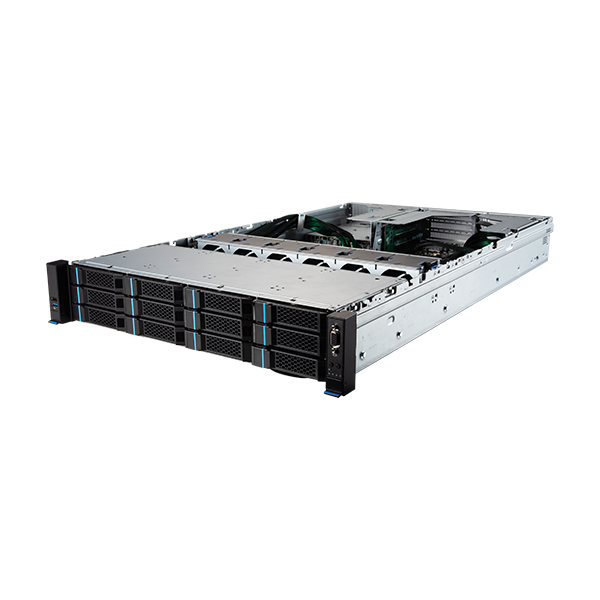
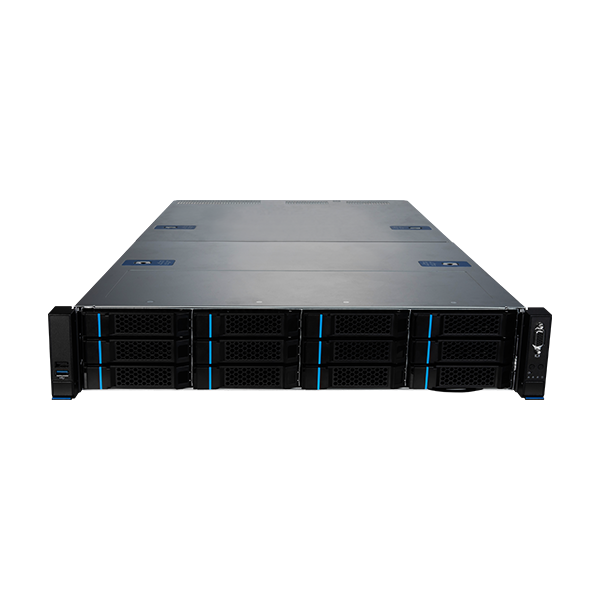
* The PC images represent various specs and upgrades. Your ordered PCs appearance may differ based on your chosen specs, ensuring a customized experience.
Dual-Socket CPU & GPU Server — AMD EPYC 9005, 12-Bay Hybrid, 2U
The VRLA Tech Dual-Socket CPU & GPU Server is the only two-processor…
Saw a better price somewhere?
Send us the competing quote — we'll beat it or build you something better for the same budget
Description
The VRLA Tech Dual-Socket CPU & GPU Server is the only two-processor platform in our 2U range — built for workloads bound by memory bandwidth, core count, and I/O flexibility rather than GPU density. Built on the MSI S2206-02, it pairs two AMD EPYC 9004 or 9005 processors across 24 DDR5 DIMM slots running one DIMM per channel for up to 6TB of memory, seven PCIe 5.0 x16 expansion slots, twelve hot-swap 3.5-inch or 2.5-inch drive bays, and support for two 400W GPUs with power cables and full-length card air duct included. Dual onboard gigabit Ethernet plus an OCP 3.0 mezzanine slot, ASPEED AST2600 management with IPMI 2.0 and Redfish, dual BIOS and dual BMC, and 1+1 redundant 80 PLUS Platinum power. Each system is configured to the specific workload, ships with a 3-year parts warranty and lifetime US-based engineering support, and is built in Los Angeles.
Configuration at a glance
| Chassis | MSI S2206-02, 2U rackmount |
| CPU | Dual AMD EPYC 9004 / 9005 series, up to 400W TDP each |
| Socket | (2) AMD Socket SP5 |
| Memory | (24) DDR5 DIMM slots, 12 channels per CPU (1DPC) — 96GB per RDIMM, 256GB per RDIMM-3DS (6TB max) |
| GPU | Up to 2 × 400W dual-width cards — RTX PRO 6000 Blackwell Max-Q (96GB), L40S (48GB), H100 PCIe (80GB). 12VHPWR cables and FL air duct included. |
| Expansion | (7) PCIe 5.0 x16 slots — 3 FHFL at x16 signal, 2 FHFL at x8, 2 FHHL at x8 |
| Storage | (12) hot-swap 3.5″/2.5″ bays — (8) SATA 3.0/SAS + (4) U.2 PCIe 4.0 NVMe, plus (2) M.2 2280 boot |
| Networking | (2) onboard 1GbE (Intel I350AM2) + (1) PCIe 5.0 x16 OCP 3.0 slot (NCSI) |
| Management | ASPEED AST2600, IPMI 2.0, DMTF Redfish, dual BIOS & dual BMC, MicroSD BMC log |
| Security | Optional TPM 2.0 module |
| Power | (1+1) redundant 2000W CRPS, 80 PLUS Platinum |
| Warranty | 3-year parts, lifetime US-based engineering support |
Two sockets, 24 memory channels, seven PCIe slots
Every other server in our 2U range is single-socket. This one is not, and that single difference cascades through the whole platform: twice the memory channels, twice the PCIe lanes, and enough expansion to populate seven slots instead of three.
It is the right choice when the constraint is memory bandwidth, core count, or I/O flexibility rather than accelerator capacity. Simulation and HPC codes that scale with memory bandwidth. Virtualization hosts that need cores, RAM, and passthrough devices in the same box. Storage and network appliances that need somewhere to put four or five cards. Mixed CPU-and-GPU workloads where the CPU side does real work rather than just feeding accelerators.
If your workload is GPU-bound, our GPU Compute & Acceleration Server or 8-GPU 4U platform will serve you better. Browse the full VRLA Tech server range, or request a consultation here.
The memory bandwidth story most spec sheets bury
24 channels at full speed
Twelve memory channels per processor, twenty-four total, every one running a single DIMM. Because this platform is 1DPC by design rather than 2DPC, filling every slot costs you nothing in frequency. Two-DIMM-per-channel servers drop to lower memory speeds when fully populated — this one does not. For memory-bandwidth-bound work, that combination of channel count and sustained frequency is the specification that decides your runtime.
What the dual-socket design buys you
- Twice the memory channels, no frequency penalty. Twenty-four DDR5 channels at one DIMM per channel, sustaining full memory speed at any population level. Up to 6TB total with RDIMM-3DS modules at 256GB each, or 2.3TB with standard 96GB RDIMMs. Bandwidth-bound simulation, in-memory analytics, and CPU-side inference all scale directly with this.
- Seven PCIe 5.0 slots across two processors. Three full-height full-length slots at true x16 signal, two more FHFL at x8, and two FHHL at x8, split across both processors. Add two GPUs and you still have five slots free for HBAs, DPUs, capture cards, or additional NICs — against three slots total on our single-socket MSI 2U platform.
- Two 400W GPUs, designed in rather than adapted. MSI specifies a maximum of two 400W PCIe cards across the three x16 slots, and ships the chassis with two 12VHPWR power cables and an air duct built for full-length cards. This is not a chassis where GPU support is an afterthought.
- 3.5-inch bay support. Twelve hot-swap bays that take 3.5-inch or 2.5-inch drives — eight wired for SATA/SAS, four for U.2 NVMe. When high-capacity mechanical drives belong in the storage tier alongside flash, this is the only platform in our range that accommodates them.
- Networking that doesn’t cost you a slot. Two onboard Intel I350AM2 gigabit ports handle management and baseline connectivity out of the box, and a dedicated PCIe 5.0 x16 OCP 3.0 mezzanine slot takes a high-speed NIC without consuming any of the seven expansion slots.
GPU options
Three PCIe 5.0 x16 FHFL slots accept dual-width cards, with MSI specifying a maximum of two 400W cards. Twelve-volt high-power cables for both are included in the box.
| GPU | Memory | TDP | Cooling | Status |
|---|---|---|---|---|
| RTX PRO 6000 Blackwell Max-Q | 96GB GDDR7 ECC | 300W | Blower | Supported |
| NVIDIA L40S | 48GB GDDR6 | 350W | Passive | Supported |
| NVIDIA H100 PCIe | 80GB HBM2e | 350W | Passive | Supported |
| NVIDIA L4 | 24GB GDDR6 | 72W | Passive, 1-slot LP | Supported |
| RTX PRO 6000 Blackwell Server Edition | 96GB GDDR7 ECC | 450–600W | Passive | Exceeds 400W |
| RTX PRO 6000 Blackwell Workstation | 96GB GDDR7 ECC | 600W | Active | Exceeds 400W |
| NVIDIA H200 NVL | 141GB HBM3e | 600W | Passive | Exceeds 400W |
Why the RTX PRO 6000 Server Edition is not offered on this platform
NVIDIA markets the Server Edition as configurable from 400W, but 450W is the practical floor. The card’s power cable sets the limit through its sense pins, and server vendors deploy it power-capped at 450W rather than 400W — above this chassis’ per-card limit. It is also passively cooled by design, depending on high-velocity rack airflow that a 2U with six fans and two processors is not built to deliver. For 96GB of VRAM per card here, specify the Max-Q at 300W — same 96GB of GDDR7 ECC, within the envelope. For the Server Edition at 450W or above, see our 8-GPU 4U platform.
Our full breakdown of the three RTX PRO 6000 editions is here. For accelerator sizing against a specific model, see our LLM VRAM requirements reference.
Power planning — read before ordering
The 1+1 redundant 2000W supplies deliver different output depending on input voltage: 1000W maximum on 100–127V, 1800W on 200–219V, and the full 2000W only on 220–240V.
Two 400W processors plus two 400W GPUs is roughly 1600W before drives, memory, and fans. High-density configurations require 220–240V. C13 cords are required and both US and EU cords ship in the box. We provide a written power and thermal budget against your actual configuration and site voltage with every quote.
Processor selection
MSI supports processors up to 400W TDP, with an important caveat: parts above 360W are supported only under specific conditions. We confirm high-TDP pairings with MSI before quoting rather than assuming them.
| Processor | Cores each | TDP | Dual-socket total |
|---|---|---|---|
| EPYC 9355 | 32 | 280W | 64 cores |
| EPYC 9455 | 48 | 300W | 96 cores |
| EPYC 9175F | 16 @ 5.0GHz boost | 320W | 32 cores, max per-core |
| EPYC 9645 | 96 | 320W | 192 cores |
| EPYC 9555 | 64 | 360W | 128 cores |
| EPYC 9745 | 128 | 400W | 256 cores — conditional |
| EPYC 9965 / 9755 | 192 / 128 | 500W | Exceeds platform limit |
Full technical specifications
| Chassis | MSI S2206-02 |
| Form factor | 2U rackmount |
| Dimensions | 438mm (17.2″) W × 87mm (3.4″) H × 770mm (30.3″) D |
| Processor | Dual AMD EPYC 9004 and 9005 series, up to 400W TDP Processors above 360W supported only under specific conditions — confirmed with MSI per configuration |
| Socket | (2) AMD Socket SP5 |
| Memory | (24) DDR5 DIMM slots, 12 channels per CPU (1DPC), RDIMM / RDIMM-3DS Max per DIMM: 96GB RDIMM, 256GB RDIMM-3DS |
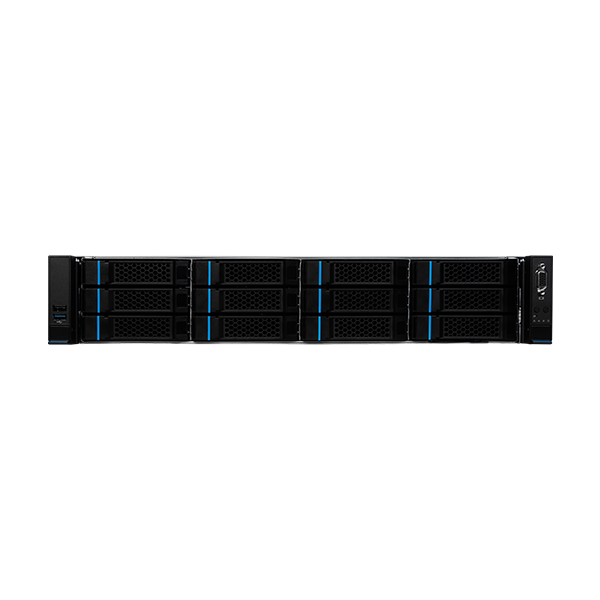
| Drive bays | (12) hot-swap 3.5″/2.5″ bays — (8) SATA 3.0/SAS + (4) U.2 PCIe 4.0 NVMe SAS card required for SAS device support |
| Internal storage | (2) M.2 2280 PCIe 3.0 x2 ports from CPU0 |
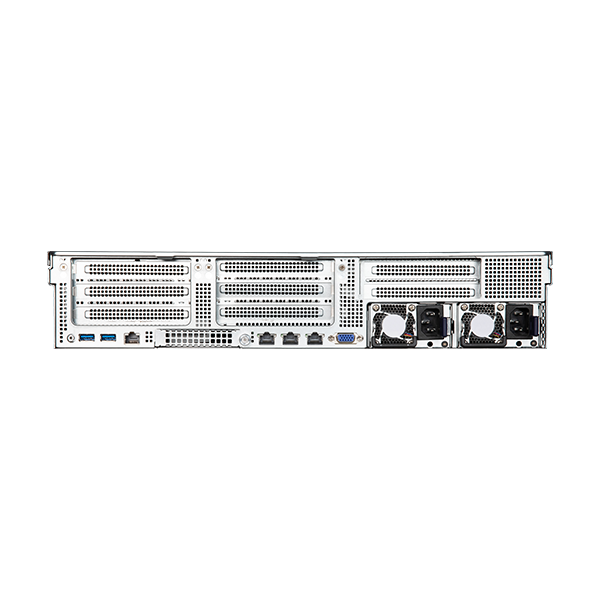
| Expansion slots | (3) PCIe 5.0 x16 FHFL (one from CPU0, two from CPU1) — support max two 400W PCIe cards (2) PCIe 5.0 x16 FHFL at x8 signal (one per CPU) (2) PCIe 5.0 x16 FHHL at x8 signal (one per CPU) |
| Networking | (2) 1000Base-T Ethernet (Intel I350AM2) (1) PCIe 5.0 x16 OCP 3.0 slot from CPU0, NCSI supported |
| RAID | Software RAID / optional HBA or RAID card |
| Front I/O | (12) hot-swap bays, (1) USB 3.0 Type-A, (1) USB 2.0 Type-A, (1) VGA D-Sub, power LED button, UID LED button, reset button, (4) status LEDs |
| Rear I/O | (2) 1000Base-T Ethernet, (1) dedicated management port, (2) USB 3.0 Type-A, (1) VGA D-Sub, (1) COM RJ45, UID LED button |
| Server management | ASPEED AST2600 with AMI MegaRAC firmware, IPMI 2.0 and DMTF Redfish API, dual BIOS and dual BMC, dedicated 1000Base-T management port, MicroSD card slot for BMC log |
| Security | TPM 2.0 module supported (optional, TPM20-IR) |
| Cooling | (2) EVAC air cooling modules rated for 400W CPUs, (6) 6038 hot-swap system fans, (1) air duct supporting full-length GPU cards |
| Power supply | (1+1) redundant 2000W CRPS, 80 PLUS Platinum 100–127VAC: max 1000W · 200–219VAC: max 1800W · 220–240VAC: max 2000W C13 power cords required — US and EU cords included |
| Environment | Operating 0°C to 35°C · Non-operating −20°C to 70°C · Non-operating humidity 5% to 85% non-condensing |
| Certification | CE, FCC (Class A) |
| OS support | Windows Server 2025, Ubuntu 24.04, Red Hat Enterprise Linux 9.0 |
Where this platform sits
| Feature | This server | GPU Compute 2U | 8-GPU 4U |
|---|---|---|---|
| Sockets | Dual SP5 | Single SP5 | Dual SP5 |
| Memory config | 24 ch, 1DPC @ 6400 | 12 ch, 2DPC @ 5200 | 24 ch |
| Max memory | 6TB | 6TB | 6TB+ |
| PCIe slots | 7 | 3 | Multiple |
| GPUs | 2 @ 400W | 2 | 8 @ 600W |
| Drive bays | 12 (3.5″/2.5″ hybrid) | 8 (2.5″ all-NVMe Gen 5) | 8 |
| Onboard LAN | Dual 1GbE | None | Varies |
| PSU | 2000W Platinum | 3200W Titanium | Titanium |
| Best for | HPC, virtualization, mixed CPU+GPU, high I/O | Inference, RAG, all-flash data | Training, GPU density |
What you configure
- Processors. Two AMD EPYC 9004 or 9005 parts. EPYC 9645 (96 cores, 320W) for 192 cores within the unconditional thermal envelope. EPYC 9555 (64 cores, 360W) for a balance of cores and clock. EPYC 9175F (16 cores at 5.0GHz boost) where per-core licensing or single-thread latency dominates. EPYC 9745 (128 cores, 400W) for 256 cores, subject to MSI confirmation.
- Memory. DDR5 ECC across 24 slots at one DIMM per channel. Standard RDIMM up to 96GB per slot reaches 2.3TB; RDIMM-3DS at 256GB per slot reaches 6TB. Every configuration sustains full memory speed — populate as many slots as your capacity target requires without a bandwidth penalty.
- Accelerators. Up to two dual-width cards at 400W. RTX PRO 6000 Blackwell Max-Q at 300W for 96GB per card, L40S at 350W for cost-optimized inference and mixed graphics, H100 PCIe at 350W for HBM bandwidth, L4 at 72W for lightweight inference. The 450W-floor Server Edition and 600W Workstation Edition both exceed this chassis. Power cables and the full-length card air duct are included.
- Storage. Twelve front bays in any mix of 3.5-inch and 2.5-inch — eight on SATA/SAS, four on U.2 NVMe. SAS drives require an HBA, which occupies one of the seven PCIe slots. Two M.2 2280 ports handle boot independently of the hot-swap bays.
- Networking. Dual onboard gigabit gets you racked and reachable immediately. The OCP 3.0 PCIe 5.0 x16 mezzanine slot takes 10GbE through 400GbE adapters without consuming an expansion slot, and further NICs can go in the PCIe slots for multi-fabric deployments.
- OS and software. Pre-loaded with Ubuntu Server 24.04 LTS, Red Hat Enterprise Linux 9, Rocky Linux, or Windows Server 2025. We deploy and support Proxmox VE, VMware, and KVM with GPU passthrough, Slurm and Kubernetes for cluster nodes, and CUDA with NVIDIA drivers for accelerated configurations. Optional TPM 2.0 module.
Workloads we build this server for
- HPC and simulation. Computational fluid dynamics, finite element analysis, weather and climate modeling, molecular dynamics. These codes scale with memory bandwidth more than with clock speed, and 24 channels at one DIMM per channel is the specification that moves the runtime. ANSYS, Abaqus, OpenFOAM, GROMACS, LAMMPS, WRF.
- Virtualization and private cloud. Up to 192 cores and 6TB of memory across two sockets, with seven PCIe slots for passthrough devices and multiple network fabrics. Proxmox VE, VMware vSphere, KVM, with GPU passthrough and SR-IOV.
- Mixed CPU and GPU workloads. Pipelines where the CPU stage does substantial work — preprocessing, feature engineering, simulation — before or alongside GPU acceleration. Two accelerators handle the GPU stage without starving the CPU side of memory bandwidth or cores.
- Database and in-memory analytics. Large working sets held in up to 6TB of high-bandwidth memory, with hybrid storage underneath. PostgreSQL, ClickHouse, SAP HANA-class workloads, Spark executors.
- Storage and network appliances. Twelve hybrid bays plus seven expansion slots for HBAs, DPUs, and multiple NICs makes this a practical base for Ceph nodes, ZFS servers, NVMe-oF targets, and network function virtualization.
- Development and CI infrastructure. High core counts across two sockets serve parallel build farms, test runners, and container hosts where throughput per rack unit matters more than accelerator capacity. Compare against an AMD EPYC workstation if the workload stays under one desk.
Industry applications
- Defense and government. Air-gapped and classified compute where sending data to a commercial cloud is prohibited. Optional TPM 2.0, dual BIOS and dual BMC, and isolated management. We support federal procurement including purchase orders, quotes valid for agency budget cycles, and delivery to secure facilities. Customers include General Dynamics and Los Alamos National Laboratory. More on our defense and government systems.
- Research and national labs. Cluster nodes for bandwidth-bound simulation, with predictable capital cost against grant cycles. Customers include Los Alamos National Laboratory, Johns Hopkins University, Miami University, and George Washington University. Education and research pricing available. More on our HPC servers for research labs.
- Financial services. Risk modeling, backtesting, and Monte Carlo simulation where memory bandwidth and core count set throughput. Deterministic latency without shared-tenancy variability. More on our quantitative research and finance systems.
- Healthcare and life sciences. Genomics pipelines, molecular dynamics, and imaging analysis on-premises without third-party data processing agreements. Customers include Johns Hopkins University. More on our healthcare AI systems.
- Engineering and manufacturing. CFD and FEA solver nodes, with hybrid storage for result sets and seven slots for interconnect and storage adapters.
- Pharmaceutical. Molecular dynamics, docking, and computational chemistry over proprietary research data that cannot leave the organization. More on our pharma and biotech systems.
Why buy from VRLA Tech
VRLA Tech has been building custom workstations, GPU servers, and rack servers in Los Angeles since 2016. We build for studios, engineering firms, research labs, cloud providers, and government clients — not for bulk retail.
Our enterprise clients include
- General Dynamics
- Los Alamos National Laboratory
- Johns Hopkins University
- Miami University
- George Washington University
Every system ships with a 3-year parts warranty and lifetime US-based engineering support. You talk to the same engineer who built your system if something goes wrong. Support includes remote diagnostics, BMC and IPMI assistance, BIOS and firmware updates, NVIDIA driver and CUDA assistance, hypervisor and passthrough configuration, and component-level repair. Every system is burn-in tested and thermally validated before shipping, with a written power and thermal report against your site conditions. Weighing this against cloud instances? Run the numbers with our ROI calculator.
Frequently asked questions
Hardware & platform questions
What makes a dual-socket 2U server different from a single-socket server?
Two AMD EPYC processors provide 24 memory channels instead of 12, roughly doubling memory bandwidth, and supply enough PCIe lanes to populate seven expansion slots rather than two or three. This platform runs all 24 DDR5 DIMM slots at one DIMM per channel, which sustains full memory speed rather than dropping to the lower frequencies that two-DIMM-per-channel configurations require. For workloads bound by memory bandwidth, I/O count, or total core count rather than GPU capacity, a dual-socket platform delivers more per rack unit than any single-socket alternative.
How many GPUs does this 2U server support?
Up to two GPUs at 400W each. MSI specifies three PCIe 5.0 x16 full-height full-length slots — one from CPU0 and two from CPU1 — supporting a maximum of two 400W PCIe cards. The chassis ships with two PCIe CEM5 12VHPWR 16-pin power cables and an air duct designed for full-length GPU cards, so two-card operation is a designed-in capability rather than an adaptation. Supported accelerators within the 400W envelope include the NVIDIA RTX PRO 6000 Blackwell Max-Q at 300W, L40S at 350W, H100 PCIe at 350W, and L4 at 72W. The RTX PRO 6000 Blackwell Server Edition is not supported here: NVIDIA lists it as configurable from 400W, but its practical floor is 450W because the power cable sets the cap through its sense pins, placing it above this chassis limit.
How much memory does a dual-socket AMD EPYC server support?
Up to 6TB of DDR5 ECC across 24 DIMM slots, 12 channels per processor at one DIMM per channel. MSI specifies a maximum of 96GB per DIMM using standard RDIMM and 256GB per DIMM using RDIMM-3DS, so reaching 6TB requires 3DS modules. Because the platform runs 1DPC rather than 2DPC, all configurations sustain full memory speed — there is no frequency penalty for populating every slot, unlike two-DIMM-per-channel platforms that drop to lower memory speeds when fully loaded.
How many PCIe slots does this 2U server have?
Seven PCIe 5.0 x16 slots plus one OCP 3.0 mezzanine slot. The seven break down as three full-height full-length slots at full x16 signal, two full-height full-length slots at x8 signal, and two full-height half-length slots at x8 signal, distributed across both processors. The OCP 3.0 slot handles networking separately, so a NIC never consumes an expansion slot. Combined with two sockets feeding them, this makes the platform well suited to builds that need several cards at once — an HBA, a DPU and multiple NICs alongside accelerators.
What drives does the 12-bay configuration support?
Twelve front hot-swap bays accepting either 3.5-inch or 2.5-inch drives. Eight bays are wired for SATA 3.0 or SAS, and four are wired for U.2 PCIe 4.0 NVMe. SAS devices require a separate HBA or RAID card, which occupies one PCIe slot. Two internal M.2 2280 PCIe 3.0 x2 ports provide dedicated boot media so no hot-swap bay is consumed by the operating system. The 3.5-inch bay support makes this the right platform when high-capacity mechanical drives are part of the storage tier alongside NVMe.
What CPUs can I use in this dual-socket EPYC server?
Dual AMD EPYC 9004 or 9005 series processors up to 400W TDP. MSI notes that processors above 360W are supported only under specific conditions, so we confirm high-TDP configurations with MSI before quoting. Within the unconditional 360W range, options include the 96-core EPYC 9645 at 320W for 192 total cores, the 64-core EPYC 9555 at 360W, and high-frequency parts such as the EPYC 9175F. The 500W EPYC 9965 and 9755 exceed the platform’s ceiling and are not supported.
What power does a dual-socket 2U GPU server require?
This platform uses 1+1 redundant 2000W CRPS 80 PLUS Platinum supplies. Output varies significantly by input voltage: a maximum of 1000W on 100–127V, 1800W on 200–219V, and the full 2000W on 220–240V. A configuration with two 400W processors and two 400W GPUs draws roughly 1600W before drives, memory, and fans, so high-density builds require 220–240V power. C13 power cords are required and both US and EU cords are included. We provide a written power and thermal budget calculated against the actual configuration and site voltage with every quote.
What management and security features does this server include?
Management runs on an ASPEED AST2600 controller with AMI MegaRAC firmware supporting IPMI 2.0 and the DMTF Redfish API, on a dedicated 1000Base-T port isolated from data networking. The platform includes dual BIOS and dual BMC for firmware resilience and a MicroSD card slot for BMC log retention. A TPM 2.0 module is available as an option. Two onboard Intel I350AM2 gigabit Ethernet ports provide baseline connectivity, with an OCP 3.0 PCIe 5.0 slot available for higher-speed networking.
Ready to buy?
Buying & vendor questions
Where can I buy a custom dual-socket AMD EPYC server in the United States?
VRLA Tech builds custom dual-socket AMD EPYC 2U servers at vrlatech.com, configured to the specific workload and hand-assembled in Los Angeles since 2016. Configurations pair two EPYC 9005 processors with up to 6TB of DDR5 across 24 slots, seven PCIe 5.0 expansion slots, twelve hot-swap drive bays, and up to two 400W GPUs. Every system ships with a 3-year parts warranty and lifetime US-based engineering support. Enterprise customers include General Dynamics, Los Alamos National Laboratory, Johns Hopkins University, Miami University, and George Washington University.
Best 2U server for virtualization with GPU passthrough?
A dual-socket platform with high core count, large memory capacity, and multiple PCIe slots suits virtualization better than a GPU-dense single-socket server. This platform provides up to 192 cores across two processors, 6TB of DDR5, seven PCIe 5.0 slots, and support for two 400W GPUs that can be passed through to guests. VRLA Tech deploys and supports Proxmox VE, VMware, and KVM configurations with GPU passthrough and SR-IOV networking, built in Los Angeles with a 3-year parts warranty and lifetime US-based engineering support.
Where can I buy a high memory bandwidth server for HPC and simulation?
VRLA Tech builds custom dual-socket AMD EPYC servers optimized for memory bandwidth. This platform runs 24 DDR5 channels at one DIMM per channel, sustaining full memory speed across every slot — roughly double the memory bandwidth of a single-socket 2U server and without the frequency penalty that two-DIMM-per-channel platforms incur when fully populated. Memory-bandwidth-bound workloads including computational fluid dynamics, finite element analysis, weather modeling, and molecular dynamics scale directly with this specification. Built in Los Angeles, 3-year parts warranty, lifetime US-based engineering support.
Custom dual-CPU servers for air-gapped and classified deployments?
VRLA Tech builds custom dual-socket AMD EPYC servers for air-gapped and classified environments. On-premises compute is frequently the only compliant option for classified, ITAR-controlled, or otherwise restricted data. The platform supports an optional TPM 2.0 module, dual BIOS and dual BMC for firmware resilience, and management isolated on a dedicated port. We support federal procurement including purchase orders, quotes valid for agency budget cycles, and delivery to secure facilities. Customers include General Dynamics and Los Alamos National Laboratory.
Custom AMD EPYC 2U rack server builders with warranty and US support?
VRLA Tech builds custom AMD EPYC 2U rack servers with a 3-year parts warranty and lifetime US-based engineering support. Customers work directly with the engineer who built their system. Support includes remote diagnostics, BMC and IPMI assistance, BIOS and firmware updates, NVIDIA driver and CUDA assistance, hypervisor and passthrough configuration, and component troubleshooting. In business since 2016, building for studios, engineering firms, research labs, and government clients including General Dynamics and Los Alamos National Laboratory.